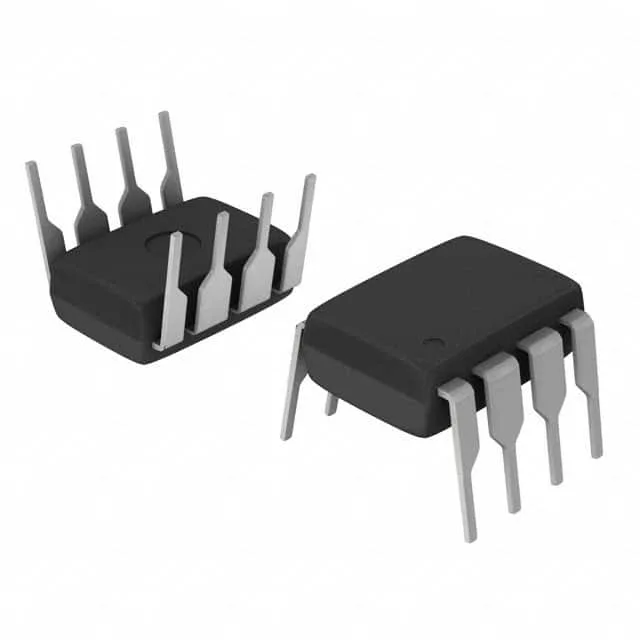
Active 16 Kbit I²C EEPROM in a through-hole PDIP-8
The Microchip AT24C16D-PUM is a 16 Kbit serial EEPROM organized as 2K x 8 bits, accessed through an I²C interface running at up to 1 MHz. The 450 ns access time and 5 ms write cycle (word/page) suit it for storing configuration parameters, calibration constants, and small lookup tables in embedded systems.
The wide supply range means the AT24C16D-PUM can sit on a 1.8 V microcontroller bus without a level shifter, or run on a 3.3 V rail in a mixed-voltage design. The I²C interface is fully specified across this range, so no timing derating is needed at the low end. For battery-powered equipment, the low-voltage operation extends run time as the cell discharges.
16 Kbit organized 2K x 8 — what fits
With 16 Kbit (2048 bytes) of non-volatile storage, this part handles a few hundred configuration registers, a small calibration table, or a boot parameter block. The 2K x 8 organization means each page write updates up to 16 bytes in a single 5 ms cycle. If your BOM needs more capacity, the AT24C16D family scales up to 256 Kbit in the same I²C protocol; if less, the AT24C08D-PUM (8 Kbit) and AT24C01C-PUM (1 Kbit) are pin-compatible drop-in alternatives in the same PDIP-8 footprint.
Through-hole PDIP-8 — prototyping and legacy fit
This is the variant to order when your board uses through-hole assembly or when you need to replace a socketed EEPROM in an existing design. The surface-mount counterpart, AT24C16D-MAHM-E, shares the same die and electrical specs but comes in an SOIC-8 for reflow assembly.
For dual-sourcing or surface-mount needs, the AT24C16D-MAHM-E (SOIC-8, tape-and-reel) is the same die in a different package.