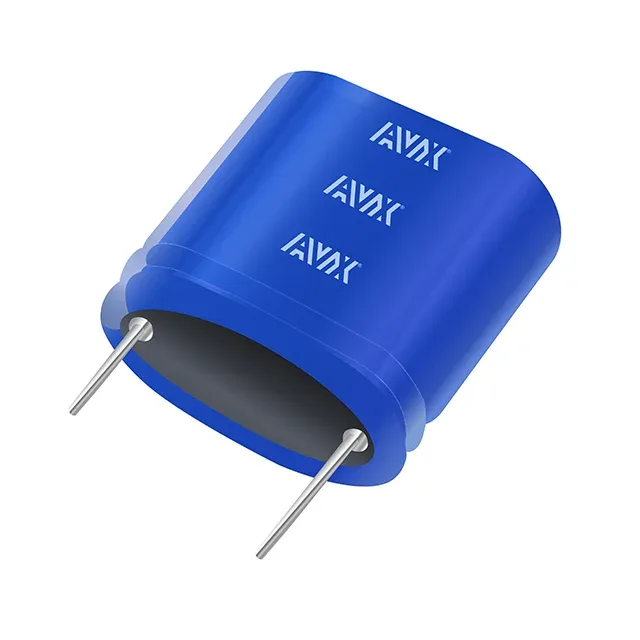
600 mF at 7.5 V — sizing the energy buffer
The SCMR18G604SRBA0: Rated 600 mF at 7.5 V, this supercapacitor stores roughly 16.9 J of usable energy (½CV²). That is the figure to use when calculating hold-up time for a power-fail ride-through or peak-current assist in a battery-backed system. The -10%, +30% tolerance means the actual capacitance can land anywhere from 540 mF to 780 mF. Budget the +30% high side in your hold-up time calculation — at 780 mF the stored energy reaches 21.9 J, which can extend the ride-through by the same margin.
225 mOhm ESR — what it means for charge and discharge current
The 225 mOhm ESR at 1 kHz sets the internal resistance that limits peak current and generates heat during charge/discharge cycles. At 7.5 V, the theoretical short-circuit current is 33.3 A (V/ESR), but the practical peak current is lower — the ESR determines the I²R heating that drives the 1000-hour lifetime at 65°C. For a pulsed-load application drawing, say, 2 A, the voltage drop across the ESR is 0.45 V — that 6% rail droop must be factored into the downstream regulator's input range.
Industrial temperature band and lifetime
The 1000-hour lifetime at 65°C is the accelerated-test baseline. At 40°C ambient, the expected life roughly doubles per 10°C drop below the rated temperature, so a 40°C environment yields approximately 8000 hours of useful service before the capacitance drifts outside tolerance.
Through-hole radial can — PCB integration
Packaged in a through-hole radial can with 0.531-inch (13.50 mm) lead spacing and PC pin termination. This is a standard two-hole footprint — no custom pad pattern or press-fit tooling required. The radial can format suits wave-solder assembly and hand-prototyping equally well. The 13.50 mm lead pitch matches common 0.531-inch grid layouts, so the part drops into a standard 0.1-inch-spaced prototype board with a simple adapter.