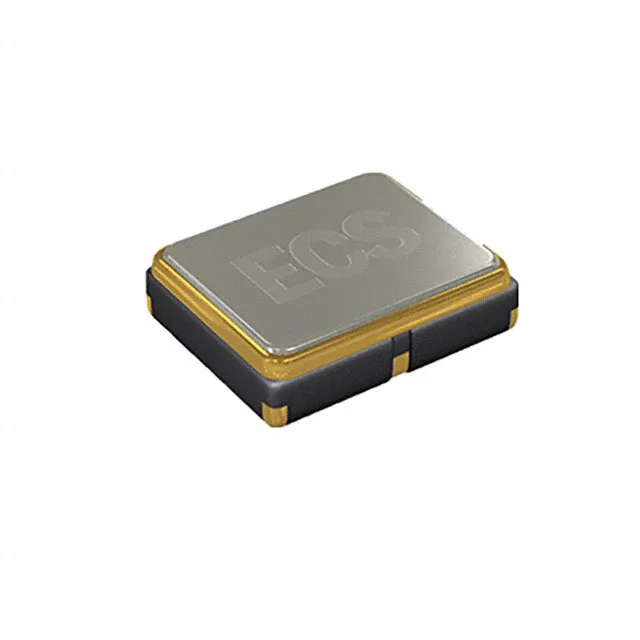
24 MHz HCMOS clock source for automotive-grade designs
The ECS-3225Q-33-240-DP-TR: HCMOS output means the drive strength is compatible with standard FPGA and MCU clock inputs without an external buffer — a single pin on the target device clocks directly from this part as long as the trace stays under the usual 20 ns propagation budget. The ±30 ppm frequency stability specification covers initial tolerance, temperature drift, and aging over the operating life — it is the combined stability budget, not a single variable. At 24 MHz, a ±30 ppm error represents a worst-case offset of ±720 Hz, which sits comfortably within the timing margin of most MCUPLL and Ethernet PHY reference clock windows.
AEC-Q200 qualification and thermal operating window
The Enable/Disable function on pin 4 lets the system drop the oscillator output to high-impedance without removing power from the device — the supply current falls to a standby level. In a wake-onCAN architecture this pin is the control point for the clock tree; confirm the target MCU OE or CLK_EN signal polarity before finalising the firmware state at cold start.
Standard 3.2 × 2.5 mm footprint for space-constrained boards
The no-lead (DFN-style) terminations require a reflow profile with a dwell above the liquidus temperature that is compatible with lead-free assembly; confirm the peak reflow does not exceed the oscillator manufacturer's recommended limit if the board also carries thermally sensitive components nearby.
Active lifecycle — no last-time-buy risk on this part
For a BOM line running this part, the sourcing posture is straightforward: quoted to order through independent distribution, with current pricing and lead time confirmed against the BOM quantity at RFQ. No last-time-buy arithmetic needed here.