65V input LDO with integrated watchdog — what it means for the rail
The MAX5023SASA: The 54dB PSRR at 100Hz means the output rejects ripple from a rectified line or alternator whine by a factor of ~500 — enough to keep a 10mVpp ripple on the input from coupling into a sensor or op-amp supply as more than ~20µVpp. Operating temperature spans -40°C to 125°C, covering the full automotive Grade 1 ambient range and industrial enclosure heat rise — the die sees the same thermal stress as the engine bay or a sealed control cabinet.
Integrated supervisory functions — watchdog, enable, reset
The MAX5023SASA packs a watchdog timer, an enable input, a reset output, and a hold input — four control features that eliminate the need for a separate supervisor IC in a microcontroller power supply. The watchdog monitors the MCU activity; if the strobe pin is not toggled within the timeout window, the reset output pulls low — this is the same function a standalone TPS3823 or MAX823 would provide, but integrated into the regulator package. Enable and hold inputs let the system sequence the rail — the enable pin shuts the output off to near-zero quiescent current, while the hold input keeps the output active during a brief input brownout.
Protection set for harsh environments
Three protection features are built in: over-temperature shutdown, reverse polarity protection, and short-circuit current limiting — the reverse polarity block alone saves an external series diode and its voltage drop. The 1.5V dropout at 150mA means the input must stay at least 1.5V above 3.3V to maintain regulation — on a 5V rail that is fine, but on a 3.6V rail the headroom is only 0.6V and the output will drop out under full load. Quiescent current is 140 µA typical — moderate for an automotive LDO with supervisory functions; the watchdog and reset circuitry account for roughly half of that draw.
Package and board-fit — 8-SOIC, no thermal paddle
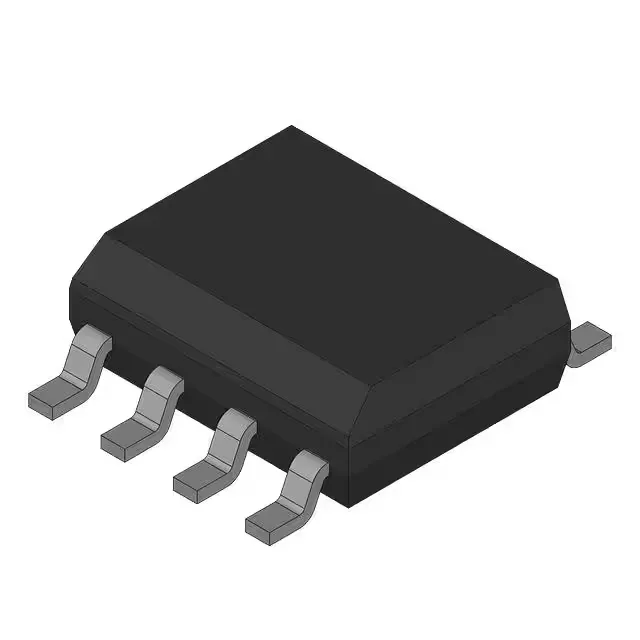
The 8-SOIC package (0.154" body width, 3.90mm) uses a standard footprint with no exposed thermal pad — the junction-to-ambient thermal resistance relies on the copper area on the PCB, so a solid ground plane pour under the package is recommended for loads above 100mA.
Active production — RoHS non-compliant flag
RoHS non-compliant — the part contains lead (Pb) above the 0.1% threshold, likely in the solder plating or die-attach. This is a hard blocker for EU RoHS-restricted BOMs; the RoHS-compliant variant (MAX5023SASA+) should be used for new designs targeting RoHS exemption expiry.