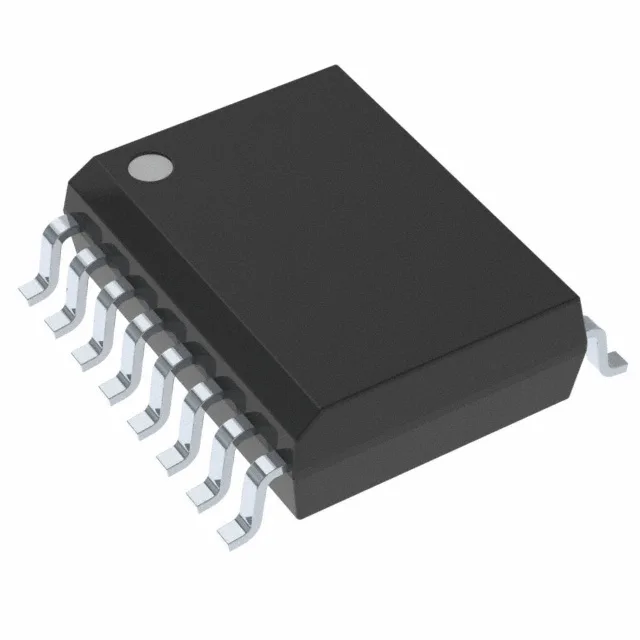
Analog Devices ADM2486BRWZ-REEL — Digital Isolators
Technical Documents PDF / CAD
RoHS Compliant · Lead-Free EIA-481 Standard
Analog Devices / Digital Isolators

ADM2486BRWZ-REEL iCoupler Isolated RS485/RS422, 20 Mbps

MPN ADM2486BRWZ-REEL
End of Life Spot Stock · 24-48h Dispatch 100% Original Sealed

Analog Devices ADM2486BRWZ-REEL, iCoupler isolated RS-422/RS-485 transceiver, 20 Mbps data rate, 2500 Vrms isolation, 25 kV/µs CMTI, 3-channel bidirectional, 3V/5V supply, -40°C to 85°C, 16-SOIC.

In Stock: 445 pcs
MOQ: 1 pcs
Logistics: DHL / FedEx DAP (Global Express · 3-7d) Russia & CIS DDP (Door-to-Door Cleared)
Dispatch: Shenzhen / HK
Unit Price (USD)
$9.23 / pc
Direct Purchase Ready
Volume Pricing Breaks Confirmed upon quotation
1+ pcs
$9.23
10+ pcs
$8.31
30+ pcs
$7.57
100+ pcs
$6.83
Working on a production BOM or have a target unit price? Submit Target Price
Buy Now

$9.23 / ea

445 in stock — maximum per order · 3–4 days lead time

$8.31 / ea from 10 pcs

Upload Full BOM List
[SPEC] Essential Parameters Snapshot Full Specifications (18)
Package / Case 16-SOIC (0.295", 7.50mm Width)
Supply Voltage 3V, 5V
ALT
Facing long factory lead times or allocation on ADM2486BRWZ-REEL? Verified pin-compatible alternatives available with active Shenzhen stock and 100% solder-ready footprint match.

Full Technical Specifications

18 Parameters
ADM2486BRWZ-REEL specifications
Parameter / AttributeSpecification / Value
TypeRS422, RS485
SeriesiCoupler®
Channel typeBidirectional
MountingSurface Mount
Supply voltage3V, 5V
Voltage - isolation2500Vrms
Isolated powerNo
Operating temperature-40°C ~ 85°C
Pulse width distortion5ns
PackageTape & Reel (TR); Cut Tape (CT)
Data rate20Mbps
TechnologyMagnetic Coupling
Case16-SOIC (0.295\", 7.50mm Width)
Channels3
Inputs - side 1/Side 22/1
Rise (Fall time)5ns, 5ns
Propagation delay tpLH (tpHL)55ns, 55ns
Common mode transient immunity25kV/µs
100% Footprint Match · Solder-Ready (No PCB Redesign Needed)

Need Stock or a Drop-in Second-Source for ADM2486BRWZ-REEL?

Package: SOIC-16 wide body (16-lead SOIC_W) · Pin-compatible replacements with immediate Shenzhen spot stock

Footprint Match 97%
Supply Chain & Allocation Reality:

The ADM2483 is the isolated half-duplex RS-485 transceiver of industrial Modbus loops, servo drives and PLC networks: a 2.5kV rms iCoupler barrier with true fail-safe receivers, a slew-limited driver, more than 25kV per microsecond of common-mode transient immunity, and a 16-pin wide SOIC that its 20 megabit PROFIBUS twin, the ADM2486, shares pin for pin. The substitution conversation around it has two halves: inside the 16-pin row it is a clean speed ladder, and outside it the trap is architectural - the 2483 isolates the DATA, and the bus-side supply must be isolated by the board. A repair that ties GND2 to logic ground has built a very robust non-isolated transceiver out of an expensive isolated one.

Verified Pin-Compatible Replacements (3 verified alternatives)

ADM2486 Analog Devices SOIC-16 wide body
100% Drop-in (Zero Code Change)
Availability & Target Pricing:

The 20Mbps PROFIBUS Member

Shenzhen Spot Stock (24-48h Dispatch)

Electrical & Core Specs:

The same 16-pin wide-body footprint at 40 times the data rate: 20Mbps against the 500kbps slew-limited 2483, PROFIBUS compliance, and an isolated DE status output the 2483 does not carry.

Same 3.0-5.0V logic side and the same isolated-bus-side discipline.

Compatibility & Drop-In Notes: A genuine same-socket speed upgrade for boards that moved to faster protocols; fitting the slower 2483 back into a PROFIBUS loop is the direction that fails at the protocol, not the pins.
Package & Solder Footprint: Same wide-body SOIC-16 land.
Shenzhen Warehouse Stock & MOQ: Stocked; quote the speed class against the protocol.
ADM2582E / ADM2587E Analog Devices SOIC-20 wide body
Functional Equivalent
Availability & Target Pricing:

The Integrated-Power Generation (isoPower)

Shenzhen Spot Stock (24-48h Dispatch)

Electrical & Core Specs:

The next generation folds the isolated DC-DC converter into the package (isoPower): the bus side powers itself from the logic side across the barrier - 16Mbps (2582E) or 500kbps (2587E) with the isolated rail included.

The whole point of the family: no separate isolated supply winding needed on the bus side - and the decoupling that comes with it (VISOOUT/VISOIN with their 0.1uF and 0.01uF capacitors) is part of the design.

Compatibility & Drop-In Notes: A 20-pin part is not a repair substitution for a 16-pin socket: the honest use is redesign and new boards, where the BOM shrinks by the whole isolated supply. For repairs, stay in the 16-pin row.
Package & Solder Footprint: 20-lead wide SOIC with its own decoupling network.
Shenzhen Warehouse Stock & MOQ: Stocked; the modern-design answer to the same requirement.
MAX13487 / MAX485 class (non-isolated) Maxim (Analog Devices) / multiple SOIC-8 / DIP-8
Functional Equivalent
Availability & Target Pricing:

The Reminder: Isolation Was the Part

Shenzhen Spot Stock (24-48h Dispatch)

Electrical & Core Specs:

Ordinary RS-485 transceivers - some with auto-direction convenience (MAX13487) - with no barrier at all: 8-pin parts that talk the same protocol across the same two wires.

Single supply, no isolation: the ground-loop current that the ADM2483 was bought to stop flows freely through the substitution.

Compatibility & Drop-In Notes: Auto-direction parts delete the DE timing the firmware manages on the 2483: moving between the two families is a firmware contract change on top of the electrical one. This card exists to make the deletion of the barrier visible before it happens.
Package & Solder Footprint: SOIC-8/DIP-8 against the 16-pin isolated body - different build entirely.
Shenzhen Warehouse Stock & MOQ: Universal stock; the baseline the isolated family is priced against.
Buyer & Quality Checklist for Sourcing Alternatives
  • Isolation is the function: the 2.5kV barrier and the >25kV per microsecond transient immunity are what the part was bought for in Modbus, VFD-adjacent and long-line industrial duty. A substitute without the barrier removes the reason the board survived its environment.
  • The supply half: the ADM2483 isolates DATA only - the bus-side (GND2/A/B) supply must itself be isolated on the board. A repair that bridges GND2 to logic ground turns the part into a non-isolated transceiver and re-opens every ground loop the design closed.
  • The 16-pin row is a pin-pure speed ladder: ADM2483 at 500kbps with 256-node support, ADM2486 at 20Mbps PROFIBUS grade with 50 - a drop-in upgrade with one network-margin number to check in the other direction.
  • The isoPower generation (ADM2582E/2587E) integrates the isolated DC-DC in a 20-pin body with its own decoupling requirements - a redesign route that deletes the isolated winding from the BOM, not a socket swap.
  • Bus protection is part of the transceiver repair: TVS clamps on A/B, the fail-safe bias network and 120-ohm end termination are what killed the old chip. Replace the protection with the silicon or schedule the second failure.
  • Direction control: half-duplex parts expect the firmware to manage DE/RE timing; auto-direction parts (MAX13487 class) delete that pin and its contract - moving between families is a firmware change as well as an electrical one.
Frequently Asked Technical Questions

Q: Can an ADM2486 replace an ADM2483?

A: Yes - the 16-pin wide-body parts are pin compatible: 20Mbps PROFIBUS grade against 500kbps, with an isolated DE status output added. The one number moving the other way is node support (50 against 256) - check long networks before the swap.

Q: What is the difference between the ADM2483 and the ADM2582E?

A: The 2582E family integrates the isolated power supply (isoPower) in a 20-pin package, powering the bus side across the barrier; the ADM2483 isolates data only and needs an isolated bus-side supply from the board. The 20-pin part is a design route, not a repair substitute.

Q: Can I use a MAX485 instead of an ADM2483?

A: It talks the same protocol, but it has no isolation. The 2.5kV barrier disappears, along with the ground-loop immunity the design was specified for. It is honest only where the bus was short and single-ground all along - otherwise the replacement deletes a safety function.

Technical Details & Description

Isolated RS-485/RS-422 transceiver with 20 Mbps throughput

The Analog Devices ADM2486BRWZ-REEL is a 3-channel bidirectional isolated RS-422/RS-485 transceiver from the iCoupler family, using magnetic coupling to deliver 2500 Vrms isolation across a 16-SOIC package.

At 20 Mbps this part sits in the fast tier of isolated RS-485 transceivers, well above the 500 kbps of the ADM2483BRWZ-REEL sibling. The 5 ns rise/fall times and 55 ns propagation delay keep the eye open for short cable runs (typically under 50 m at full speed) where throughput matters more than reach.

Industrial temperature grade and isolation rating

The 2500 Vrms isolation withstands transient surges common in industrial environments, and the 25 kV/µs common-mode transient immunity ensures data integrity when adjacent power switches commutate. No isolated power is integrated on-chip — an external DC-DC or isolated supply is needed for the bus side.

Frequently asked questions

What is the data rate of ADM2486BRWZ-REEL?

The ADM2486BRWZ-REEL supports data rates up to 20 Mbps, with 5 ns typical rise/fall times and 55 ns max propagation delay.

Are there alternatives to ADM2486BRWZ-REEL for RS-485 isolation?

For a lower-speed option, the ADM2483BRWZ-REEL runs at 500 kbps with the same 2500 Vrms isolation and bidirectional channels. For higher isolation voltage (5000 Vrms) at 16 Mbps, the ADM2491EBRWZ-REEL7 is a unidirectional alternative. The ADM2482EBRWZ offers 16 Mbps in a tube package.

What is the difference between ADM2486BRWZ and ADM2486BRWZ-REEL?

The ADM2486BRWZ and ADM2486BRWZ-REEL are electrically identical. The -REEL suffix indicates Tape & Reel packaging for automated pick-and-place; the non-REEL variant ships in tube or cut tape.

ADM2486BRWZ-REEL
Verified Allocation
Quote