SP4T RF multiplexer for 2.5 GHz signal paths
The ADG904BCPZ-REEL7 is a single-pole four-throw (SP4T) multiplexer/demultiplexer from Analog Devices, designed to route RF signals up to 2.5 GHz. The -3dB bandwidth of 2.5 GHz means it passes signals through the selected channel with minimal roll-off across the entire ISM band, GPS, and cellular sub-3 GHz bands — the insertion loss stays flat well past 1 GHz, so it works in antenna-switching or filter-bank selection without needing a separate gain stage to compensate for bandwidth limiting. Crosstalk is specified at -58 dB at 100 MHz — this tells you how much of the signal on an unselected channel bleeds into the active path. At -58 dB, the isolation is roughly 800:1 in voltage terms, which is enough to keep a strong transmitter on one port from desensitising a receiver on another port in a TDD radio front-end.
Supply, switching, and temperature envelope
Operates from a single supply between 1.65 V and 2.75 V, making it compatible with 1.8 V and 2.5 V logic rails common in baseband processors and RF transceivers. The switching times — 10 ns turn-on, 16 ns turn-off — set the minimum channel-switching interval; at 10 ns, you can cycle through all four ports in under 100 ns, which suits fast-hopping or time-interleaved measurement systems. Channel capacitance is 2 pF (CS(off), CD(off)) — this off-capacitance, combined with the load impedance, sets the upper frequency limit when the channel is deselected. Leakage current is 1 µA max, negligible in all but the highest-impedance bias networks.
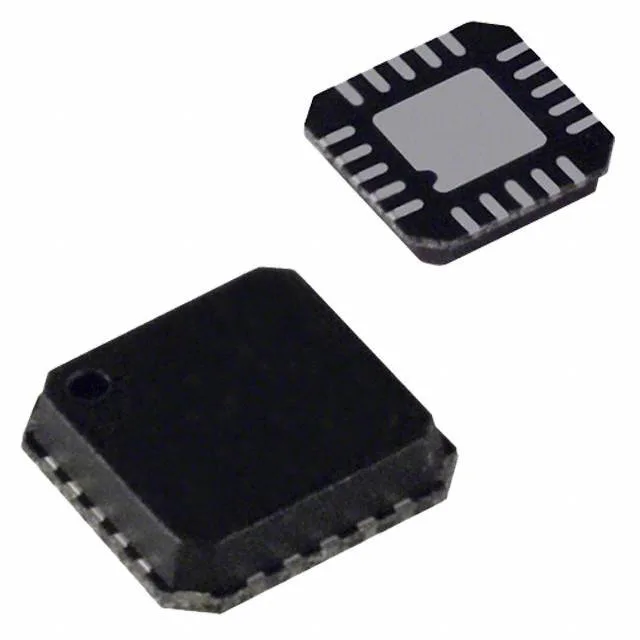
Supplied on Tape & Reel (TR) or Cut Tape (CT) — the REEL7 suffix indicates a 7-inch reel quantity. The 20-LFCSP (4x4 mm) has a 0.50 mm pitch, which demands a solder-paste stencil aperture that matches the pad size on the datasheet footprint; the exposed paddle needs a central ground-plane via array to keep the thermal resistance low and the RF return path short. RoHS3 compliant per — no exemptions for lead in solder, so the part is compatible with standard lead-free reflow profiles (peak 260°C).