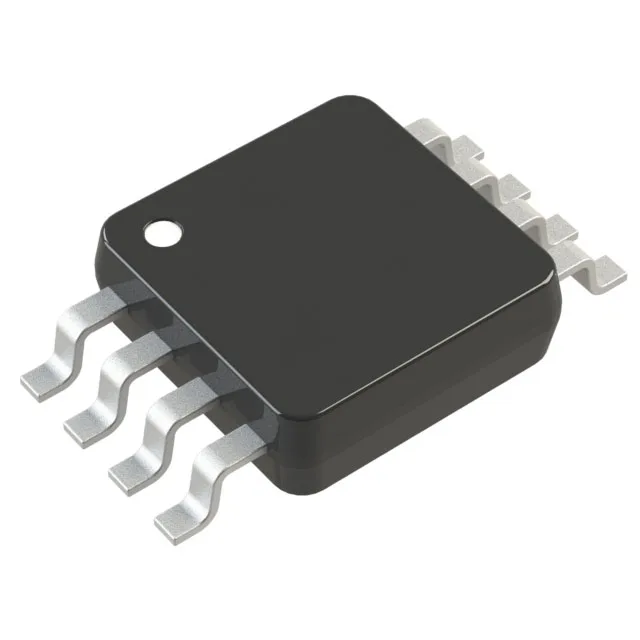
Signal-conditioning front-end for precision sensor bridges
The AD8237ARMZ-R7 is a single-supply instrumentation amplifier from Analog Devices, designed to extract small differential signals from bridge sensors, thermocouples, and medical electrodes while rejecting common-mode noise. Its 200 kHz -3 dB bandwidth and 0.15 V/µs slew rate set the upper bound for the signal frequencies it can faithfully amplify — adequate for strain-gauge and load-cell outputs that change slowly, but not for high-speed data acquisition above a few tens of kilohertz. The 115 µA quiescent current makes it a fit for battery-powered or loop-powered transmitter designs where every microamp is budgeted.
Offset, bias, and the precision floor
For a 350 Ω strain-gauge bridge excited at 5 V, the offset error at the amplifier output is roughly 25 µV referred to input — well below the bridge's own imbalance. The 250 pA bias current into a 10 kΩ source impedance creates only 2.5 µV of additional offset, negligible in most industrial front-ends. The output can source or sink 4 mA per channel, enough to drive the input of a successive-approximation ADC directly or to swing a 4-20 mA transmitter loop through a precision resistor.
Package, supply, and temperature range
The -R7 suffix denotes Tape & Reel packaging — 7-inch reel, 3000 pieces per reel — intended for automated pick-and-place assembly. The Cut Tape variant is also available for prototyping.