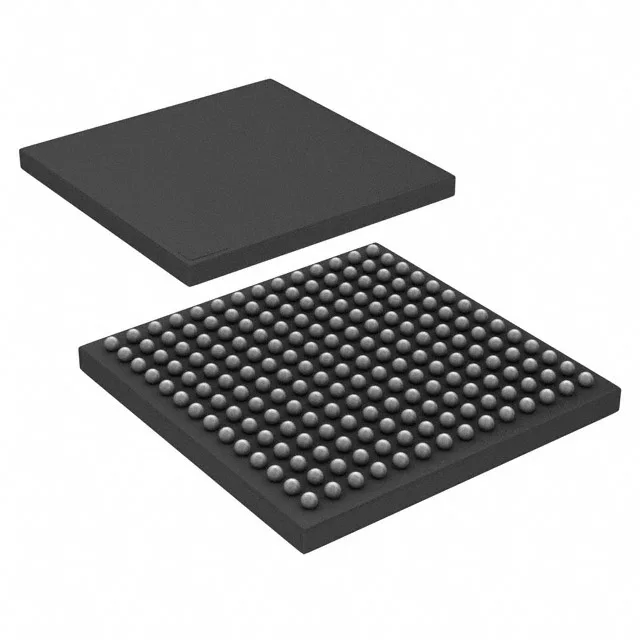
12 800 logic cells — mid-density Spartan-7 for sensor fusion and I/O expansion
The AMD XC7S15-2FTGB196I is a Spartan®-7 FPGA delivering 12 800 logic elements in a 196-ball CSPBGA package. With 100 user I/O and 360 Kbit of block RAM, it targets glue-logic consolidation, sensor interface bridging, and display control where a mid-density LUT budget is needed but a larger Artix or Kintex would overshoot the BOM.
I/O count and package — what the 100 I/O in a 196-ball BGA means for the layout
100 I/O on a 196-ball CSPBGA (15x15 mm, 0.8 mm pitch) leaves roughly half the balls for power and ground — that ratio keeps simultaneous switching noise manageable on a 4-layer board with solid VCCINT and VCCAUX planes. The core supply is 0.95 V to 1.05 V; the I/O banks run on separate rails, so the 100 I/O can mix 3.3 V, 2.5 V, and 1.8 V standards across banks without external level shifters. The 1000 CLB slices (LABs) feed the 12 800 logic cells — each slice contains four 6-input LUTs and eight flip-flops, giving a usable register count well above the LUT count for pipelined datapaths.
For a BOM cost engineer, the single-source risk here is real — the Spartan-7 family has no direct pin-compatible second source. The XC7S15 sits below the XC7S25 in density; if the design needs headroom, the 25K LE part shares the same 196-ball footprint and supply rails for a drop-in migration path within the same PCB layout.
No blanket stock claim; each RFQ is quoted with lot traceability and manufacturer warranty.