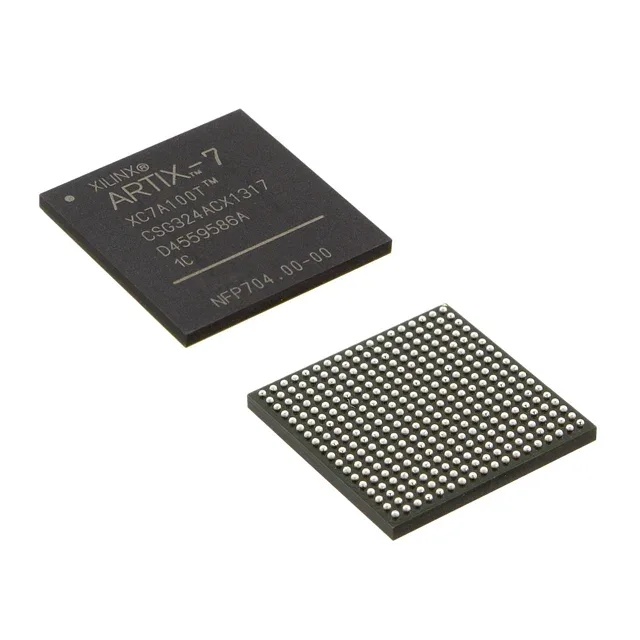
33,280 logic cells — the density that decides the fit
The AMD XC7A35T-L1CSG324I is an Artix-7 FPGA with 33,280 logic cells organized into 2,600 CLB slices. That density puts it in the mid-range of the Artix-7 family — enough fabric to absorb a soft-core processor, a few high-speed serial interfaces, and glue logic, without the cost or power of the larger 200K-cell parts. The 1,843,200 total RAM bits handle on-chip buffering and FIFO storage, so you can keep the external SRAM off the board for moderate-depth pipelines. The 210 user I/O in the 324-CSPBGA package means every ball on the 15x15 mm array is an I/O — no dedicated power balls stealing pins. That's enough for a 32-bit bus, a DDR memory interface, and a handful of control signals, all routed on a 4-layer board if you keep the fan-out disciplined.
That's the industrial band — outdoor telecom cabinets, factory-floor controllers, and engine-bay-adjacent electronics where the ambient hits 85°C and the self-heating adds another 15°C. The core supply rail is 0.95V to 1.05V, a tight 100 mV window that demands a regulator with better than 3% accuracy — a standard 1.0V LDO with 1% tolerance keeps the core inside the envelope across load steps.
Active production — no end-of-life notice on record
The XC7A35T-L1CSG324I is listed as Active with no NRND or EOL flag. That means AMD is still manufacturing it, and the supply chain is stable through authorized distribution. ROHS3 compliant — no exemptions expiring, no red-list substances to document for EU or UKCA declarations. The Artix-7 family has been in volume production for years, and the 324-ball footprint is shared across multiple density grades — if the design later needs more fabric, the XC7A50T or XC7A75T in the same package is a drop-in swap without a board spin.