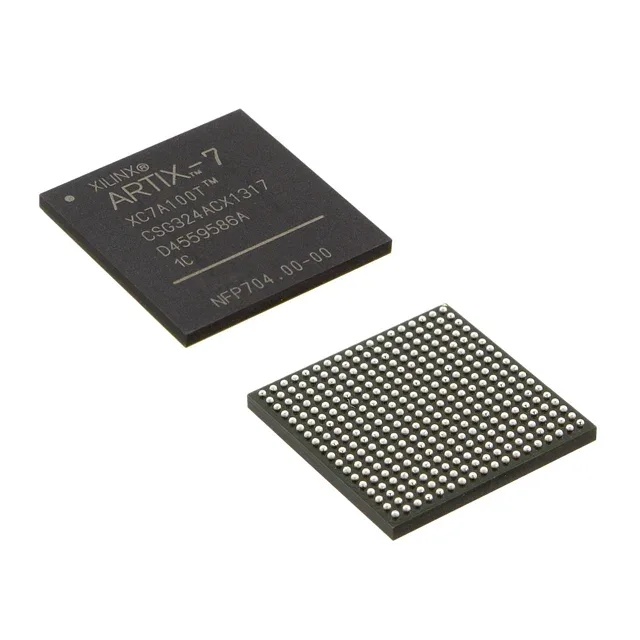
Logic density and I/O budget for mid-range designs
The XC7A35T-1CSG324C packs 33,280 logic cells arranged in 2,600 CLB slices, giving you enough fabric for a soft-core processor, a few DSP pipelines, and a modest state machine without running out of routing resources. With 210 user I/O in a 324-ball CSPBGA package, you get a balanced ratio of logic to pins — enough to interface a parallel LCD, a DDR memory bus, and a handful of SPI/I2C peripherals before you hit the pad limit.
On-chip memory and supply rail planning
The 1,843,200 total RAM bits — 1.8 Mbit — live in block RAM primitives that you can configure as FIFOs, single- or dual-port RAM, or ROM. This is enough for a 256-byte packet buffer per channel across a dozen channels, or a small frame buffer for a VGA display. Core voltage must stay within 0.95 V to 1.05 V, so the supply rail needs a regulator with tight load regulation — a 1.0 V LDO or a switching converter with remote sense is typical. The 0.95 V minimum means the FPGA will brown out if the rail dips below that during a transient. The 324-ball CSPBGA measures 15x15 mm with a 0.8 mm ball pitch. That pitch forces a 4-layer PCB minimum for fan-out — two-layer boards will struggle to route the inner balls to the periphery without blind vias.
Temperature grade and deployment environment
The commercial temperature range of 0°C to 85°C limits this variant to indoor, climate-controlled equipment — server racks, lab instruments, telecom central offices. It is not rated for automotive engine bays or outdoor enclosures in direct sunlight. AMD lists the XC7A35T-1CSG324C as Active and ROHS3 compliant, so there is no end-of-life pressure for new designs. The Artix-7 family has broad tool support in Vivado, and the -1 speed grade is the entry-level timing tier — adequate for 200-300 MHz clock domains in most logic paths.