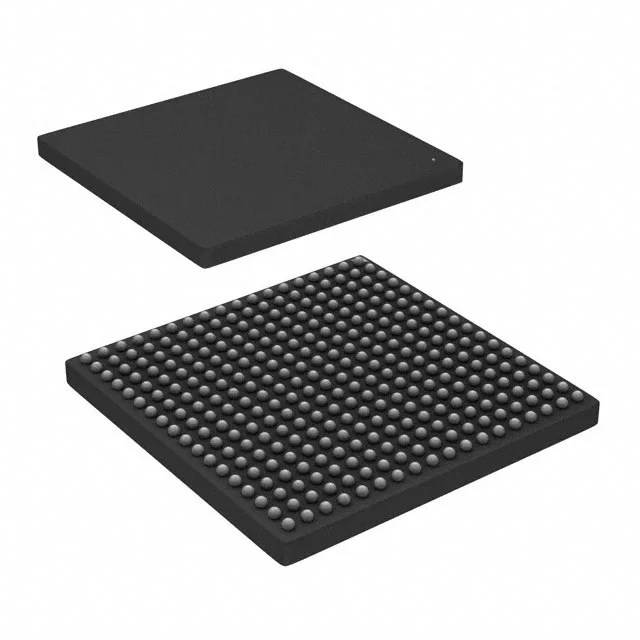
Artix-7 FPGA — logic capacity and I/O for mid-density designs
The AMD XC7A12T-1CSG325I is an Artix-7 family FPGA with 12800 logic elements (1000 LABs/CLBs) and 150 user I/O, housed in a 324-ball CSPBGA (15x15 mm) package. This places it in the entry-to-mid range of the Artix-7 line, suitable for bridging, sensor aggregation, and control logic where you need more than a CPLD but don't require the full fabric of a larger 7-series device.
On-chip memory and supply — block RAM budget and core rail
The 737280 total RAM bits (720 Kbit) are distributed across block RAM primitives — enough for moderate FIFO buffers, coefficient tables, or small packet caches. For a 12800-logic-cell device, this memory-to-logic ratio supports typical data-path applications without needing external SRAM for scratchpad storage. Core supply is 0.95 V to 1.05 V, the standard 1.0 V nominal for 28 nm 7-series FPGAs. The I/O banks operate from separate supply rails (not listed here, but per the Artix-7 architecture they accept 1.2 V to 3.3 V depending on the bank). The narrow core tolerance means the voltage regulator must stay within 50 mV of the target — a 1% accurate rail is recommended.
This covers outdoor telecom cabinets, factory-floor controllers, and automotive test equipment without active cooling, as long as the junction stays under 100°C.