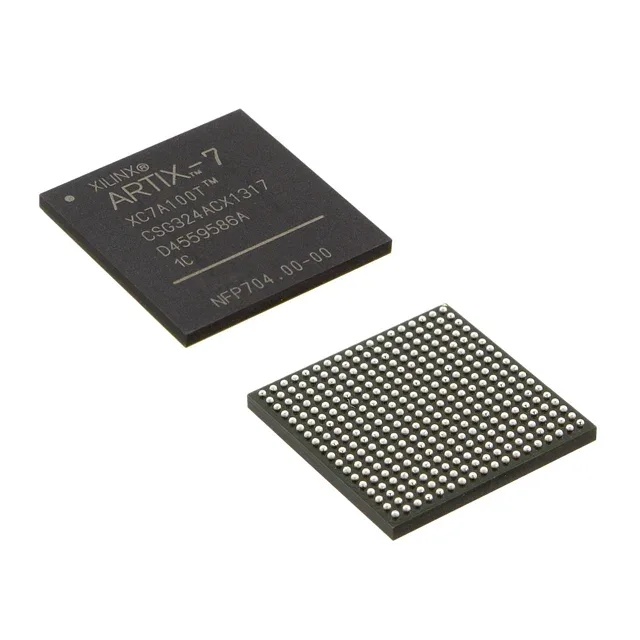
What the 33,280 logic cells and 1.8 Mbit BRAM mean for your design
The XC7A35T-1CSG324I is an AMD Artix-7 FPGA with 33,280 logic cells organised into 2,600 CLB slices. That puts it in the mid-range of the Artix-7 family — enough fabric for a soft-core RISC-V processor, a few high-speed serial interfaces, and some glue logic, without the cost or power of a Kintex or Virtex part. The 1,843,200 bits of block RAM give you about 225 KB of on-chip memory. For a typical application — say a 1080p video scaler or a multi-axis motor controller — that BRAM can hold a few line buffers or a small lookup table, but you will likely need external DDR for frame stores or large data sets. With 210 user I/O in a 324-ball CSPBGA, the pin density is moderate. The 15x15 mm package is a hand-solderable BGA — a decent rework station can handle it, but the 0.8 mm ball pitch means a 4-layer PCB is the practical minimum for fan-out.
Industrial temperature grade and supply rails
That covers most factory-floor, outdoor telecom, and automotive-cabin deployments — but not under-hood (125°C) or military (125°C) environments. Core voltage is 0.95 V to 1.05 V — a tight window. A 1.0 V rail with ±2% regulation is the safe bet; the FPGA's internal power-on reset monitors this rail and holds the configuration in reset until it stabilises.
The device is ROHS3 Compliant, meaning it meets the latest EU restriction on hazardous substances.