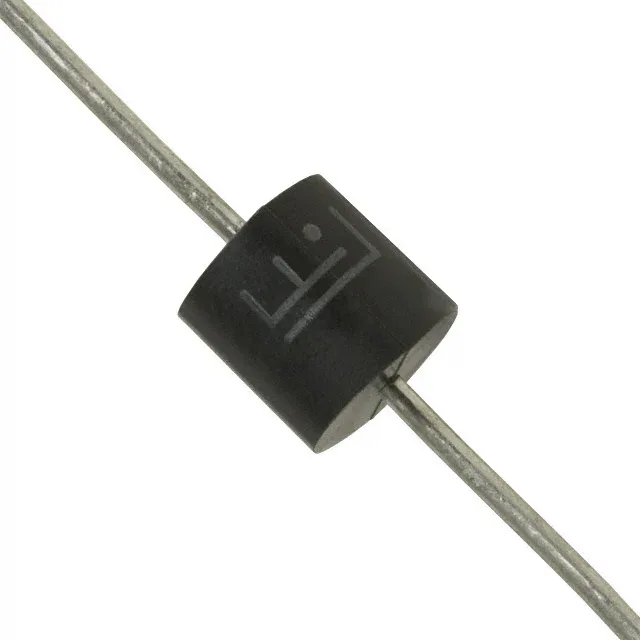
5 kW peak pulse — what the clamping rating means
The 5KP16CA/B clamps transients with a 5000 W peak pulse rating at the 10/1000 µs wave shape — that energy window is the standard telecom and industrial-surge profile, so the part is routinely specified in AC-line protection stages, DC bus clamp networks, and automotive 12 V load-dump suppression. The reverse standoff sits at a typical 16 V, meaning the protected rail can sit below 16 V in normal operation without the TVS conducting.
P600 axial package and temperature grade
The P600 axial body mounts through-hole on the PCB and is typically hand-soldered or wave-soldered in production — the lead length matters for thermal dissipation since the peak pulse energy is conducted through the package leads to the PCB copper. Junction temperature is rated to 150 °C, so the part survives the thermal self-heating from a single 10/1000 µs surge without exceeding the Tj limit.
Bidirectional Zener TVS — what CA means
The CA suffix denotes a bidirectional TVS — both polarities of transient are clamped symmetrically around the standoff voltage, which is why it carries one bidirectional channel rather than a unidirectional polarity orientation. In a floating DC rail or an AC-coupled node, a bidirectional part is the correct selection where a unidirectional TVS would falsely clamp the positive or negative half-cycle in normal operation.