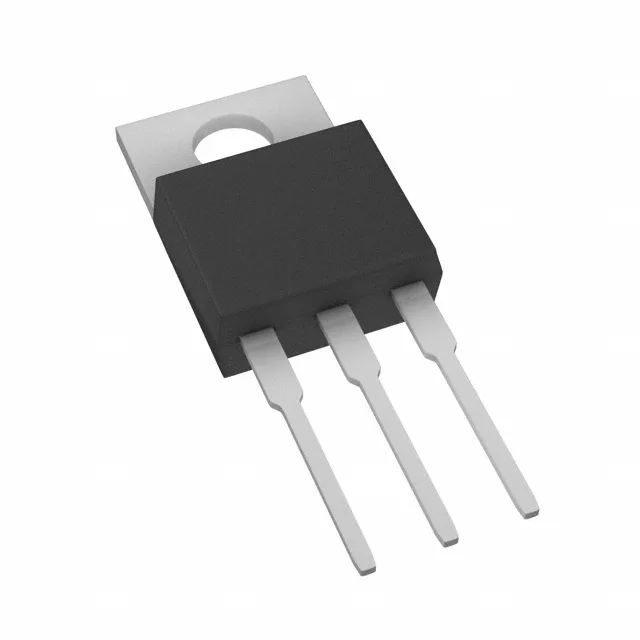
Vishay Siliconix IRF9540PBF-BE3
MOSFET P-CH 100V 19A TO220AB
Full Technical Specifications
14 Parameters| Parameter / Attribute | Specification / Value |
|---|---|
| FET type | P-Channel |
| Mounting | Through Hole |
| Drain to source voltage | 100 V |
| Current - continuous drain (Id) @ 25°C | 19A (Tc) |
| Power dissipation | 150W (Tc) |
| Operating temperature | -55°C~175°C(TJ) |
| Package | Tube |
| Vgs | ±20V |
| Technology | MOSFET (Metal Oxide) |
| Case | TO-220-3 |
| Vgs(th) (Max) @ id | 4V @ 250µA |
| Rds on (Max) @ id, vgs | 200mOhm @ 11A, 10V |
| Gate charge (Qg) (Max) @ vgs | 61 nC @ 10 V |
| Input capacitance (Ciss) (Max) @ vds | 1400 pF @ 25 V |
Need Stock or a Drop-in Second-Source for IRF9540PBF-BE3?
Package: TO-220AB · Pin-compatible replacements with immediate Shenzhen spot stock
The P-channel TO-220 row is the high-side switch of practical electronics: loads that must sit above ground and switch on the positive rail, driven straight from logic with a level-shifting transistor and no bootstrap - the circuit simplicity that keeps these parts alive in 12V and 24V designs. The IRF9540 is the classic -100V face of the row (the P-counterpart of the IRF540 lineage) and its on-resistance shows the age; the IRF4905 is the modern brute (-74A at 20 milliohms, but only -55V) and the IRF5210 the middle ground that keeps the 100V rating with triple the original conductance. All three are standard-drive parts, and every substitution in this row is decided by two numbers: rail voltage and the gate drive actually available.
Verified Pin-Compatible Replacements (3 verified alternatives)
The Modern Brute - Watch the Voltage Ceiling
Shenzhen Spot Stock (24-48h Dispatch)
The high-current member: -55V / -74A with on-resistance about 20 milliohms at -10V gate - ten times the conductance of the IRF9540, with a gate charge (120-180nC) to match.
The -55V ceiling caps it at 48V rails and below - the whole trade against the 9540s -100V.
The 100V Middle Ground
Shenzhen Spot Stock (24-48h Dispatch)
The balanced member: -100V / -40A with about 60 milliohms at -10V - three times the IRF9540s conductance at the same voltage rating and similar power class.
Full -100V class; the direct answer where a 9540 ran hot but the rail forbids the 4905.
The Lighter Original Sibling
Shenzhen Spot Stock (24-48h Dispatch)
The -100V / -12A member of the same original generation: the same vintage 200-milliohm-class on-resistance at lower current - the part where a 9540 design was already at the edge.
Same -100V class.
Buyer & Quality Checklist for Sourcing Alternatives
- The P-channel drive rule: the gate must go below the source to switch on, and the source sits on the positive rail. A small NPN level shifter (or open-drain logic) does the job - no bootstrap, no charge pump, which is the entire reason to choose P-channel for high-side loads.
- Standard drive, again: the on-resistances above are specified at -10V gate. From a 5V rail directly, every part in this row under-drives and heats - use the level shifter the circuit expects, and a pull-up to the rail to hold the switch off at boot.
- Rail voltage decides the member: -55V stops at 48V rails (IRF4905), -100V for everything above (IRF9540 legacy, IRF5210 modern, IRF9530 light). Never trade the voltage ceiling for conductance on a transient-rich rail.
- P-channel conductance costs silicon: at equal ratings a P-MOSFET on-resistance runs several times the N-channel die - that is why the rule of thumb sends high-side switching above about 5-10A back to N-channel plus a bootstrap driver.
- Gate charge sets the drive impedance: the 4905/5210 class wants a low-impedance pull-up (or driver) for credible switching edges; a 100k pull-up and a lazy transistor turn a low-Rds part into a linear heater.
- In repair, the P-MOSFET usually dies of gate overvoltage (rail transients through the level shifter) or load dump - check the gate network and any clamp before fitting the replacement, or the new part inherits the death certificate.
Frequently Asked Technical Questions
Q: What is the difference between IRF9540 and IRF4905?
A: Voltage and conductance: IRF9540 is -100V / -19A at about 200 milliohms, IRF4905 is -55V / -74A at about 20. The 4905 is the modern low-loss part but only suits rails to 48V; the 9540 survives the higher-voltage rails it was designed for.
Q: Can I drive an IRF9540 directly from a 5V microcontroller?
A: Not properly - the family is standard-drive (on-resistance at -10V gate). Use an NPN or small-MOSFET level shifter with a pull-up to the source rail so the gate actually swings below the source. Direct 5V drive leaves the channel partially enhanced and the part hot.
Q: When should I use N-channel instead of P-channel for high-side switching?
A: Above roughly 5-10A of load: N-channel conductance is several times better at equal die area, in exchange for a bootstrap or charge-pump gate supply. The P-channel row wins below that by circuit simplicity, not by efficiency.