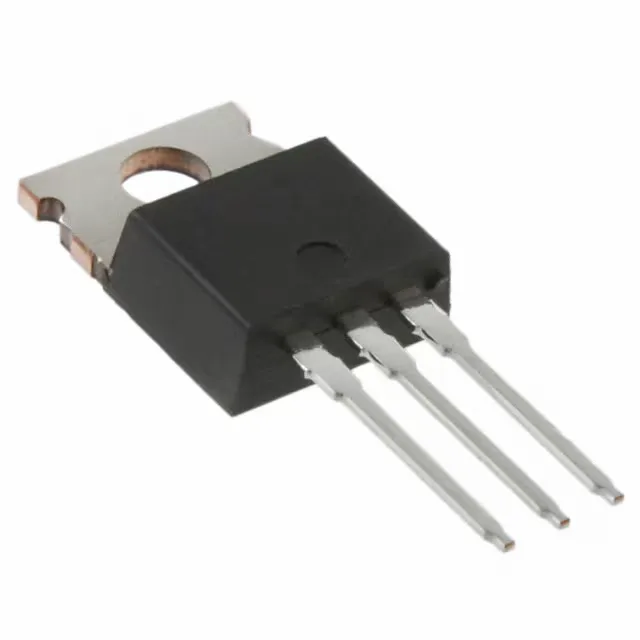
Vishay Siliconix IRF540PBF
MOSFET N-CH 100V 28A TO220AB
Full Technical Specifications
15 Parameters| Parameter / Attribute | Specification / Value |
|---|---|
| FET type | N-Channel |
| Mounting | Through Hole |
| Drain to source voltage | 100 V |
| Drive voltage (Max rds on, min rds on) | 10V |
| Current - continuous drain (Id) @ 25°C | 28A (Tc) |
| Power dissipation | 150W (Tc) |
| Operating temperature | -55°C~175°C(TJ) |
| Package | Tube |
| Vgs | ±20V |
| Technology | MOSFET (Metal Oxide) |
| Case | TO-220-3 |
| Vgs(th) (Max) @ id | 4V @ 250µA |
| Rds on (Max) @ id, vgs | 77mOhm @ 17A, 10V |
| Gate charge (Qg) (Max) @ vgs | 72 nC @ 10 V |
| Input capacitance (Ciss) (Max) @ vds | 1700 pF @ 25 V |
Need Stock or a Drop-in Second-Source for IRF540PBF?
Package: TO-220AB · Pin-compatible replacements with immediate Shenzhen spot stock
The IRF540N is the most famous TO-220 N-MOSFET in the world - the default choice of motor drivers, LED strips and hobby-class power switching, and still a production part in industrial boards. Three things make it the most-swapped MOSFET: the standard-drive specification (its low on-resistance is rated at a 10V gate, so a 5V microcontroller pin only half-drives it), a very common counterfeit problem at flea-market prices, and a suffix history (IRF540 versus the improved IRF540N die) that buyers confuse. The logic-level part of the same family, IRLZ44N, is the correct answer to most of these situations.
Verified Pin-Compatible Replacements (5 verified alternatives)
The Logic-Level Answer
Shenzhen Spot Stock (24-48h Dispatch)
N-channel 55V / about 50A logic-level MOSFET: the low on-resistance spec (roughly 22-28 milliohms) applies at a 5V gate, so 3.3V and 5V logic drive it fully where the IRF540N is half-enhanced.
VDSS 55V versus 100V on the IRF540N - the voltage ceiling is the trade for the easy drive.
Lower Voltage, Lower Loss
Shenzhen Spot Stock (24-48h Dispatch)
55V / 49A standard-drive MOSFET with on-resistance about 17.5 milliohms at 10V - conducts better than the IRF540N below 55V but needs the same 10V-class gate drive.
VDSS 55V; same standard-drive caveat at 5V gates.
The High-Current Ladder Step
Shenzhen Spot Stock (24-48h Dispatch)
55V / about 110A with on-resistance near 8 milliohms at 10V - the standard choice when currents outgrew the IRF540N but the voltage stays under 55V.
VDSS 55V; standard gate drive at 10V.
Logic-Level at the Full 100V
Shenzhen Spot Stock (24-48h Dispatch)
The logic-level member of the 100V family: same 100V class as the IRF540N with the 5V-compatible gate, for circuits that need both the voltage ceiling and easy drive.
VDSS 100V; on-resistance rated at the logic-level gate.
The 55V Row, Lower Current
Shenzhen Spot Stock (24-48h Dispatch)
The 55V standard-drive member rated 17A with on-resistance about 70 milliohms at 10V and 45W dissipation - the lighter sibling in the same TO-220 body, still fully avalanche rated.
VDSS 55V; standard-drive specification like IRF540N and IRFZ44N - its low on-resistance also lives at the 10V gate.
Buyer & Quality Checklist for Sourcing Alternatives
- Gate drive is the specification that fails first: the IRF540N low on-resistance is rated at VGS = 10V. At 5V it works in the linear region - hot, lossy, and the classic "works on the bench, dies in the box" failure. Drive standard parts at 10-12V or fit a logic-level part.
- VGS(th) (2-4V on these parts) is the turn-off threshold, not a drive voltage - full enhancement needs roughly 2-3 times that number.
- The IRF540 and IRF540N are different dies: the N is the improved generation with lower on-resistance. Relabeled stock selling "N" parts that measure like the old die is a known market problem - verify lots.
- Above 55V the logic-level family ends: a 100V rail cannot use IRLZ44N. The correct easy-drive part there is the IRL540 (logic-level, 100V).
- A gate resistor and pull-down are not optional decoration: they set switching speed against ringing, and guarantee the FET is off while the MCU boots.
- For sustained current, do the dissipation arithmetic (I squared times RDS(on), hot) before deciding on a heatsink; the package can pass currents the board cannot get rid of thermally.
Frequently Asked Technical Questions
Q: Why does my IRF540N overheat when the Arduino pin drives the gate?
A: Because 5V is under-driving it: the part needs about 10V at the gate to reach its rated on-resistance. At 5V it operates in the linear region and burns the difference as heat. Fix it with a logic-level MOSFET (IRLZ44N below 55V, IRL540 for 100V) or a proper 10-12V gate driver.
Q: Can IRLZ44N replace IRF540N directly?
A: In circuits up to 55V it is the standard substitution - same TO-220 footprint and pin order, fully driven at 5V. The trade is the lower voltage ceiling: above 55V use the IRL540 to keep both the logic-level drive and the 100V class.
Q: What is the difference between IRF540 and IRF540N?
A: The N suffix is the improved die generation with lower on-resistance at the same 100V / 33A ratings class. They are interchangeable in practice, but the market mixes them - and counterfeit N-marked parts that measure like the older die are common.