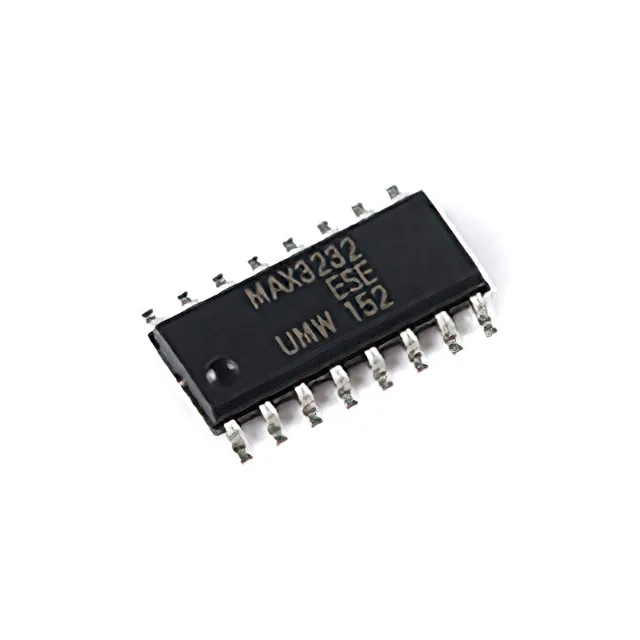
UMW MAX3232ESE
IC TRANSCEIVER FULL 2/2 16SOP
Full Technical Specifications
11 Parameters| Parameter / Attribute | Specification / Value |
|---|---|
| Type | Transceiver |
| Mounting | Surface Mount |
| Supply voltage | 3V ~ 3.6V, 4.5V ~ 5.5V |
| Protocol | RS232 |
| Operating temperature | 0°C ~ 70°C (TA) |
| Duplex | Full |
| Package | Tape & Reel (TR) Cut Tape (CT) |
| Data rate | 250kbps |
| Case | 16-SOIC (0.154\", 3.90mm Width) |
| Receiver hysteresis | 300 mV |
| Number of drivers (Receivers) | 2/2 |
Need Stock or a Drop-in Second-Source for MAX3232ESE?
Package: DIP-16 / SOIC-16 · Pin-compatible replacements with immediate Shenzhen spot stock
The MAX232 is the chip that taught two generations of engineers what a charge pump does: a 5V RS-232 transceiver that generates its own positive and negative rails for the serial port with four capacitors and nothing else. Its long life produced three capacitor generations that get mixed freely at the bench - the original MAX232 with 1uF caps, the MAX232A at 0.1uF, and the MAX3232 which is pin-compatible, runs from 3.3V as well, and draws a tenth of the current. The substitution works in the good direction almost always; the failure mode is fitting 0.1uF caps to a genuine original MAX232 and wondering why the port is dead.
Verified Pin-Compatible Replacements (3 verified alternatives)
The 0.1uF Generation
Shenzhen Spot Stock (24-48h Dispatch)
The second-generation die: same pinout and function, faster charge pump, higher slew rate (200kbps class), designed around 0.1uF capacitors instead of 1uF.
5V supply with the same internal +/-rail generation; verify the rail voltages at pins 2 and 6 after fitting (about +9V and -9V on a working part).
3.3V Capable, 10x Lower Current
Shenzhen Spot Stock (24-48h Dispatch)
The modern member: 3.0V to 5.5V supply (works from 3.3V logic rails directly), 0.1uF caps, supply current in the 0.3mA class against about 5mA for the original.
3.0V to 5.5V - fits both 5V legacy and 3.3V boards; the RS-232 side still meets the +/-5V output requirement.
The Second-Source Row
Shenzhen Spot Stock (24-48h Dispatch)
The classic second-source generation of the MAX232 function: ICL232, ST232, SP232, ADM232 and HIN232 all occupy the same DIP-16 as the original.
5V supply; capacitor generation varies by vendor - older second sources want 1uF, so read the datasheet of the exact part fitted.
Buyer & Quality Checklist for Sourcing Alternatives
- The capacitor generation rule: original MAX232 wants 1uF charge-pump capacitors; MAX232A, MAX3232 and most modern dies want 0.1uF. A genuine MAX232 fitted with 0.1uF caps produces weak or missing +/- rails and a dead port - the classic silent repair failure on this part.
- First measurement on any suspect board: pin 2 (V+) should read about +9V and pin 6 (V-) about -9V with no load. If the rails are absent, the charge pump is not running - check the four capacitors and their ground returns before blaming the chip.
- MAX3232 is the drop-in modernization for both 5V and 3.3V sockets with 0.1uF caps and about a tenth of the supply current - the honest standard for new designs and board reworks.
- The C3 high-side wiring differs in the fine print between the 232/232A (V+ to supply) and the 3232 (VCC or GND allowed) - when crossing generations, read the figure for the die actually fitted.
- Second-source names (ICL232, ST232, SP232, ADM232, HIN232) are electrically the same function but their documented capacitor generations differ; pairing the caps to the die, not to the board silkscreen, is the rule.
- All family members are static-sensitive CMOS charge pumps: handle in ESD practice, and keep the pump capacitors close to the pins - long loops turn the pump into an antenna.
Frequently Asked Technical Questions
Q: Can I replace a MAX232 with a MAX3232?
A: Yes - pin-identical drop-in that adds 3.3V capability and cuts supply current about tenfold. Use 0.1uF capacitors and check the C3 wiring figure; the RS-232 side still meets the +/-5V output requirement.
Q: Why did my MAX232 stop working after a capacitor change?
A: Likely a capacitor-generation mismatch: the original MAX232 needs 1uF charge-pump caps, while MAX232A/MAX3232 use 0.1uF. Verify the die fitted, match the caps to it, and confirm the rails at pins 2 and 6 (about +9V and -9V).
Q: What is the difference between MAX232 and MAX232A?
A: The A is the second-generation die: same pinout and function but faster charge pump and higher slew rate, designed around 0.1uF capacitors against 1uF for the original. The A works in every MAX232 socket; the reverse needs the original capacitors restored.