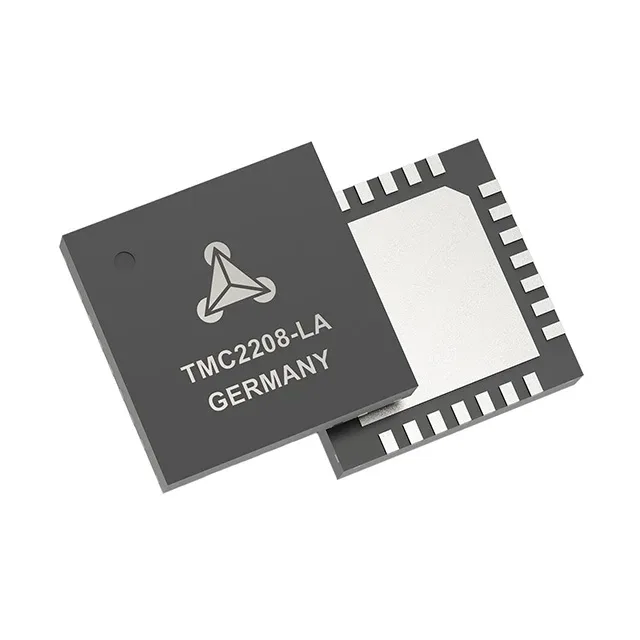
TMC2208-LA-T Stepper Driver 1.2A 36V 28-QFN — Trinamic | ICBOMS
IC MTR DRV BIPOLAR 5.5-36V 28QFN
Full Technical Specifications
14 Parameters| Parameter / Attribute | Specification / Value |
|---|---|
| Mounting | Surface Mount |
| Motor type - stepper | Bipolar |
| Voltage - load | 5.5V ~ 36V |
| Supply voltage | 5.5V ~ 36V |
| Output current | 1.2A |
| Interface | Logic, UART |
| Operating temperature | -40°C~125°C(TJ) |
| Package | Tape & Reel (TR); Cut Tape (CT) |
| Function | Driver - Fully Integrated, Control and Power Stage |
| Technology | Power MOSFET |
| Applications | General Purpose |
| Case | 28-VFQFN Exposed Pad |
| Step resolution | 1 ~ 1/256 |
| Output configuration | Half Bridge (4) |
Need Stock or a Drop-in Second-Source for TMC2208-LA-T?
Package: QFN-28 (die) / StepStick 16-pin module · Pin-compatible replacements with immediate Shenzhen spot stock
The StepStick footprint turned the A4988 into the default stepper driver of desktop 3D printers, CNC routers and camera rigs, and then into a family: the DRV8825 as the 1/32 upgrade in literally the same socket, the TMC2208 as the silent generation designed as an A4988 replacement. The socket is genuinely shared - the Vref arithmetic is not. Each generation sets motor current with a different formula (and different sense resistors on clone boards), so the classic failure of this family is a swap that fits perfectly and drives the motor at twice or half the intended current. This page exists to make the trimmer math explicit before the smoke.
Verified Pin-Compatible Replacements (3 verified alternatives)
The 1/32 Upgrade in the Same Socket
Shenzhen Spot Stock (24-48h Dispatch)
Pin-for-pin the same board: 8.2V to 45V motor supply against the A4988 35V ceiling, up to 1/32 microstepping, and the same STEP/DIR/enable interface - but the jumper table and the Vref formula both move.
The maths is the headline: at the common 0.1 ohm sense resistor, A4988 trip current is Vref / (8 x Rs) while DRV8825 chopping current is Vref / (5 x Rs) - the same Vref commands roughly double the current on the 8825.
The Silent Drop-In With Shifted Pins
Shenzhen Spot Stock (24-48h Dispatch)
The silence generation: StealthChop chopping removes the audible whine, 256 microsteps are interpolated internally from MS1/MS2 settings (2/4/8/16), and the datasheet-plus-AN-045 route treats it as a functional A4988 replacement.
4.75V to 36V motor supply; stand-alone current setting at the 0.11 ohm sense resistor lands at about Imax = Vref x 0.93, so Vref is numerically close to the motor current - a third formula in the same socket.
The Clone Lottery - Read Rsense First
Shenzhen Spot Stock (24-48h Dispatch)
The unbranded A4988 boards that fill the market: the die is usually the real function, but the sense resistors decide the current math - Pololu originals historically at 0.05 ohm, most clones at 0.1 ohm, some at 0.2 ohm.
Same 8V to 35V operating class; the current you command at a given Vref changes with Rsense above.
Buyer & Quality Checklist for Sourcing Alternatives
- One socket, three formulas: A4988 trip current is Vref / (8 x Rs), DRV8825 is Vref / (5 x Rs), TMC2208 stand-alone is about Vref x 0.93 at its 0.11 ohm sense resistor. Dialing a remembered voltage from another generation is the classic burn.
- Rsense is board-level, not chip-level: Pololu A4988 boards used 0.05 ohm historically, most clones 0.1 ohm, some 0.2 ohm. Read the sense resistor before writing any formula into the notebook.
- The jumper truth changes with the generation: A4988 caps at 1/16 (all three high), DRV8825 makes all-high 1/32 - after any swap, steps-per-mm in the firmware must be recomputed or every dimension prints wrong.
- Never adjust Vref with a metal screwdriver on a live board: measure at the trimmer with a meter, motor at standstill - a slipped probe across the driver is a dead driver and potentially a dead mainboard rail.
- The StepStick footprint runs hot by design: the die rating is not the module rating in still air - 1A-class continuous with a heatsink and airflow is the realistic ceiling on most boards, and the stepper housing temperature is the honest gauge.
- TMC2208 swaps are mapping exercises, not position swaps: the CP2 capacitor, ROSC to GND, and the inverted DIR (boards mount rotated) come from the AN-045 replacement guide - follow it pin by pin.
Frequently Asked Technical Questions
Q: Is the DRV8825 a drop-in replacement for the A4988?
A: The board and pins, yes; the settings, no. The jumper table moves (all-high is 1/32 against 1/16) and the Vref formula changes to Vref = Imax x 0.5 at 0.1 ohm against the A4988 equivalent of Imax x 0.8 - the same trimmer voltage commands about double the current.
Q: Can a TMC2208 replace an A4988?
A: It is designed as one (Analog Devices AN-045 details the pin-by-pin replacement), with caveats: an added capacitor on pin 5, ROSC tied to GND, MS3 and RESET repurposed, and DIR inverted - which is why the boards are often documented to mount rotated. Map the pins; never swap by position.
Q: Why did my stepper motor get hot after changing the driver board?
A: Current arithmetic. Each generation converts Vref to current with a different formula, and clone boards change the sense resistor underneath the formula. Recompute from the motor rating and the actual Rsense value before trusting any remembered Vref number.