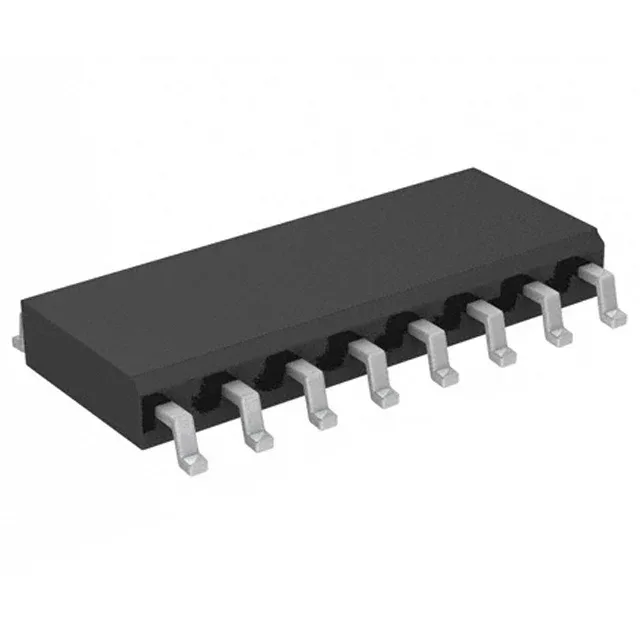
Toshiba Semiconductor 74HC175D — Microcontrollers & Processors (MCU / MPU / DSP)

74HC175D D-Type Flip-Flop, 63 MHz, 16-SOIC

MPN74HC175D
End of Life

74HC175D, 74HC series, D-type flip-flop, positive edge triggered, complementary outputs, master reset, 63 MHz clock frequency, 2V to 6V supply, 16-SOIC package, -40°C to 125°C operating temperature.

$0.44Ref. price · indicative, final on quote
Packaging16-SOIC (0.154", 3.90mm Width)
RoHSROHS3 Compliant
Series74HC
Independent supplier — new & surplus stockAuthenticity-screened · ESD-safe packingListing updated Jul 2026

Specifications

74HC175D specifications
ParameterValue
TypeD-Type
Series74HC
Output typeComplementary
Trigger typePositive Edge
MountingSurface Mount
Voltage2V ~ 6V
Current - quiescent4 µA
Current - output high, low5.2mA, 5.2mA
Frequency63 MHz
Operating temperature-40°C ~ 125°C (TA)
PackageTape & Reel (TR); Cut Tape (CT)
FunctionMaster Reset
Case16-SOIC (0.154\", 3.90mm Width)
Input capacitance3 pF
Number of elements1
Number of bits per element4
Max propagation delay @ v, max CL24ns @ 6V, 50pF

Product details

The 74HC175D is a positive-edge-triggered D-type flip-flop from the 74HC family, packing four flip-flops with complementary outputs and a master-reset function into a 16-SOIC package. Its 63 MHz clock frequency sets the upper bound for synchronous data capture in a 5V or 6V system — useful for moderate-speed counters, shift registers, or bus-interface hold registers. The 24 ns propagation delay at 6V, 50 pF load gives a hard floor for clock-to-Q timing; at 5V the delay will be slightly longer, and at 3.3V expect it to stretch further still, so budget accordingly if you're running at lower supply voltages.

Supply range and temperature — industrial and automotive capable

Rated for 2V to 6V supply, the 74HC175D runs comfortably at 5V (the classic TTL legacy rail) and at 3.3V for mixed-voltage logic. Quiescent current sits at 4 µA, so it won't burden a shared power rail in a power-sensitive design.

Output drive and capacitive load

For heavier loads (long backplane traces, high fan-out, or capacitive loads above 50 pF), plan on external buffers or a higher-drive logic family. The input capacitance is 3 pF, so the clock line won't load the source heavily.

Package and footprint — 16-SOIC

No exposed pad, no thermal vias needed — just a straightforward two-row footprint.

Frequently asked questions

Is 74HC175D suitable for 5V operation?

Yes. The supply range is 2V to 6V, and 5V is the most common operating point for this 74HC family part. The 24 ns propagation delay spec at 6V, 50 pF gives a reference; at 5V expect slightly higher delay, but well within typical 5V logic timing budgets.

What is the difference between 74HC175 and 74HC174?

The 74HC174 is a hex (6-bit) D-type flip-flop without complementary outputs and without a master-reset pin. The 74HC175 is a quad (4-bit) flip-flop with complementary outputs and a master-reset input. The 74HC175's master reset allows synchronous clearing of all flip-flops with a single pin, which the 74HC174 lacks.