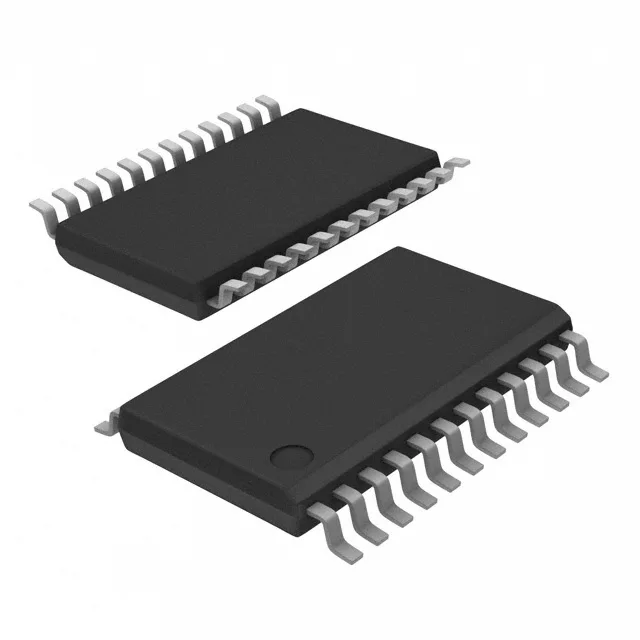
8-bit bus transceiver for 5V backplane and peripheral interfaces
It provides bidirectional data flow between two buses (A and B ports) with a direction control (DIR) and output enable (OE) for bus isolation. The 32 mA source and 64 mA sink drive capability handles heavily loaded backplanes, memory arrays, or peripheral buses in industrial control, telecom line cards, and test equipment where 5 V logic still dominates.
Output drive and bus loading — what the 32 mA / 64 mA rating means
The 32 mA output high and 64 mA output low current are not just headline numbers — they determine how many standard TTL or CMOS inputs this part can drive. At 5 V, a single LSTTL load draws roughly 20 µA high and 0.4 mA low, so the SN74ABT646PW can fan out to hundreds of inputs before the DC limit is reached. The real constraint is the AC load: the 24-TSSOP package's thermal impedance limits simultaneous switching of all eight outputs at full drive. In practice, keep the bus capacitance under 50 pF per line when running at 50 MHz+ to avoid signal degradation. The 3-state outputs let multiple transceivers share the same bus without contention — essential for multiplexed address/data buses or multi-drop backplanes.
Package and footprint — 24-TSSOP
The 0.173" (4.40 mm) width is narrower than a standard SOIC-24, saving board area. This is a single-element (one 8-bit channel) device — one DIR pin controls the direction for all eight bits simultaneously.
Lifecycle and supply — active, no end-of-life risk
For dual-sourcing resilience, the SN74ABT2245DW (same 74ABT family, same 32 mA drive, same 24-TSSOP package) is a pin-compatible functional alternate — qualify it now if your BOM currently single-sources this line.