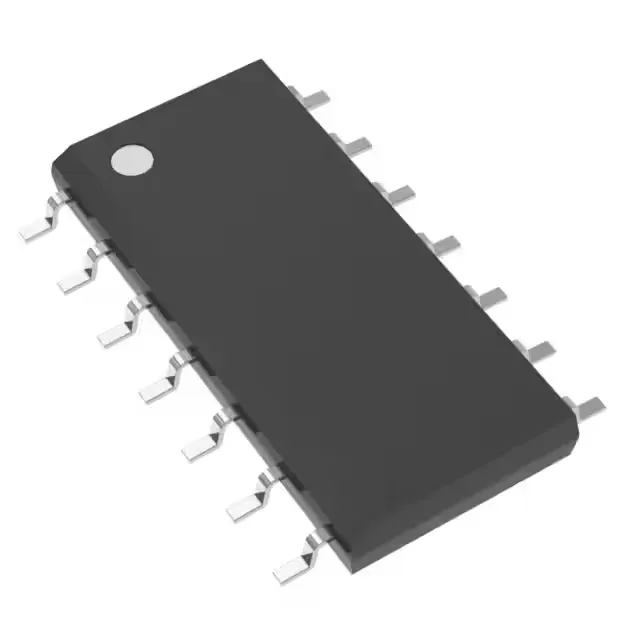
The Texas Instruments SN74ABT126D is a 74ABT-series quad buffer with non-inverting logic and 3-state outputs, packaged in a 14-SOIC. Each of the four elements handles one bit, with independent output-enable control per channel.
Supply voltage and input tolerance — the 5V-only constraint
The supply range is 4.5V to 5.5V, and the inputs are not 5V-tolerant in the sense of accepting 3.3V signals without a level shifter. If you are feeding this buffer from a 3.3V microcontroller or FPGA, the input-high threshold (V_IH) is typically 2.0V minimum for the 74ABT family, so a 3.3V CMOS output at 3.0V minimum still meets V_IH. But the input pins are referenced to the 5V rail — there is no separate V_CCIO. Running the part at 5V and driving inputs from 3.3V logic works as long as the 3.3V driver's V_OH exceeds the 2.0V threshold, which it usually does. However, the input clamp diodes to V_CC mean a 3.3V signal will forward-bias the upper diode if the 5V rail is present — not a problem at 3.3V, but if the 5V rail is off and the 3.3V signal is live, you risk latch-up or excessive current. Sequence the supplies: bring up V_CC first, or use a level translator if the 3.3V side powers independently.
Output drive and fan-out budgeting
Each output can source 32mA and sink 64mA. That is a 2:1 sink-to-source ratio typical of BiCMOS drivers. For a 5V CMOS load with 10pF input capacitance, one output can drive about 50 standard 74HC inputs (each drawing ~1µA DC) while maintaining the rated V_OH/V_OL. If you are driving a terminated backplane or a long trace, the 64mA sink capability handles unterminated lines up to about 50Ω characteristic impedance with a 2.5V swing. The 3-state outputs go high-impedance when the output-enable pin is low, which lets you wire-OR multiple buffers onto a shared bus without contention — useful in multiplexed address/data buses or shared interrupt lines.