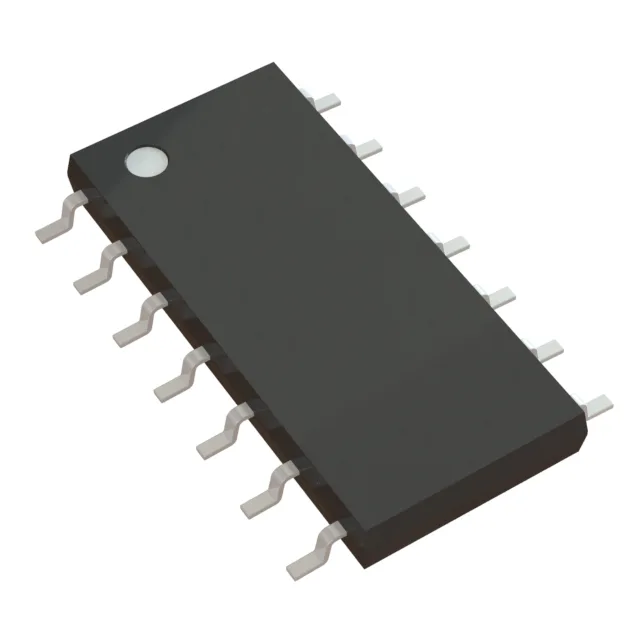
The TS274CDT is a quad CMOS operational amplifier from STMicroelectronics, packing four independent op-amps into a single 14-SOIC package. With a 3.5 MHz gain-bandwidth product, it handles signals up into the low-MHz range before the open-loop gain starts dropping. Each of the four channels draws 1 mA from the supply rail, so the whole chip burns about 4 mA quiescent. The 1 pA input bias current is negligible for high-impedance sources like photodiode or pH probe front-ends — the offset voltage drift from bias current across a 10 MΩ source resistor is under 10 µV. Supply range runs from 3 V to 16 V single or split supply, covering most common rail voltages in battery or line-powered gear.
14-SOIC footprint and temp grade
The supplier device package is 14-SO, so the reel marking and carrier tape match the standard EIA-481 embossed carrier. That covers most indoor and office environments but not automotive or extended industrial; if the board sees -20°C or 85°C ambient, look at the TS271IDT peer which spans -40°C to 125°C. The CMOS amplifier type gives rail-to-rail output swing close to the supply rails — useful when running from a 3 V rail and you need every millivolt of headroom. Output current is 45 mA per channel, enough to drive a small speaker, an ADC input, or a cable capacitance without an external buffer.
Active and available to source
The closest functional peer is the TS27M2CDT — same CMOS input stage, same 1 pA bias, but that part is a dual (two channels) with 1 MHz GBW and 0.6 V/µs slew rate. If your design needs four channels and the higher slew rate, the TS274CDT is the right pick; if you only need two channels and can trade speed for lower supply current, the TS27M2CDT saves board space and power.