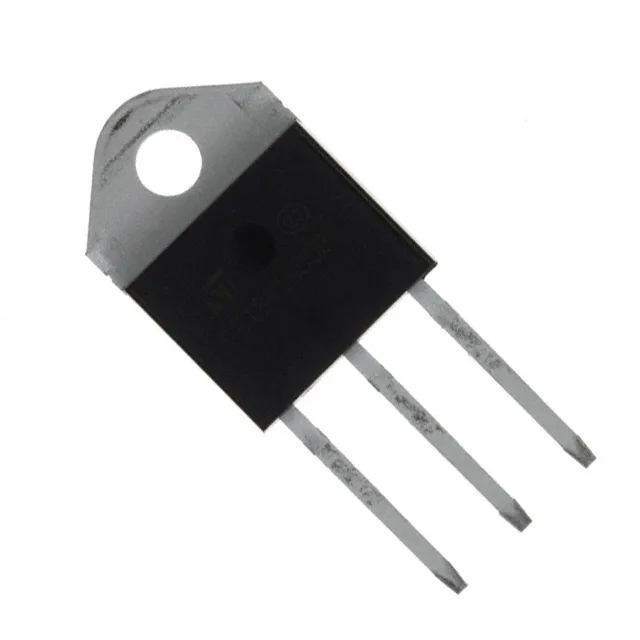
40 A RMS, 800 V — what the ratings mean for the load
The TPDV840RG is an STMicroelectronics Alternistor Snubberless TRIAC rated for 40 A RMS on-state current and 800 V off-state blocking voltage. At 40 A continuous, it switches resistive and inductive AC loads like heaters, motor starters, and transformer primaries without needing an external snubber network across the triac — the Snubberless construction handles the dV/dt from inductive switching internally. The 800 V off-state rating gives headroom on a 480 VAC line (peak ~678 V) and comfortably covers 400 VAC three-phase systems. On a 240 VAC single-phase line the margin is generous, so voltage transients from contactor dropout or nearby VFD switching are less likely to push the part into breakover.
Surge and inrush — 370 A non-repetitive
Non-repetitive surge current is rated 350 A at 50 Hz and 370 A at 60 Hz. That covers the cold-start inrush of a resistive heater bank or the magnetising inrush of a small transformer — the triac must survive a few cycles of high current before the load current settles to the 40 A RMS steady-state. The 50 mA hold current (Ih) means the triac stays latched once triggered, even with a lightly loaded inductive leg. Gate trigger current is 200 mA max at 1.5 V — a standard logic-level gate driver or a microcontroller output through a transistor can fire it without a separate driver IC.
TOP-3 through-hole — bench rework and thermal management
The TOP-3 through-hole package (also called TOP3) has a metal tab on the back that carries the main current path. In a rework scenario, the tab sinks heat fast — preheat the board to 100-120 °C before applying the iron to the leads, or the solder joint on the tab may not wet before the lead cools. The tab is electrically live (MT2 terminal), so the heatsink must be electrically isolated or the mounting hole must float. A panel-mounted heatsink in a ventilated enclosure keeps the junction below 125 °C even at 40 A RMS with a moderate duty cycle.