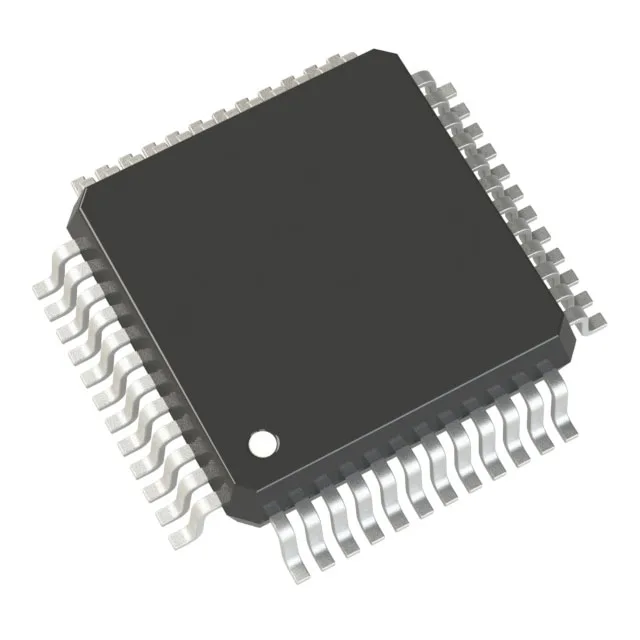
What the 16 MHz core and 64 KB flash mean on the bench
The STM8L151C8T6: That memory split — 64 KB code space against 4 KB working memory — means the firmware image can be substantial, but the runtime heap and stack are tight; a buffer-heavy application will push into external SRAM or a larger part. The 2 KB of embedded EEPROM (2K x 8) stores calibration constants, configuration parameters, or fault logs without wearing the Flash program memory. This is a genuine advantage on a repair bench — if a board's EEPROM region has been cycled past endurance, the MCU itself may still be good, and the data can be re-initialised via the I²C or SPI boot path.
Analog front-end coverage without external converters
A 25-channel 12-bit ADC and dual 12-bit DAC are integrated on-chip. For a multi-sensor data logger or a control loop reading four thermocouples, two strain gauges, and a pressure transducer, the ADC channel count eliminates the need for an external multiplexer. The dual DAC can output two independent setpoints or a differential control voltage without an external op-amp buffer.
Supply range and temperature grade for deployment decisions
No external boost converter is needed for the MCU rail in a portable device. A controller mounted in an outdoor enclosure or an unheated factory bay will stay within spec through a winter night and a summer afternoon.
On a rework bench, a hot-air profile at 260°C peak with a preheat soak at 150°C will lift this cleanly without damaging the adjacent passives. 41 I/O lines are available in this package. For a board with a parallel LCD, a keypad matrix, and a few sensor interrupts, the I/O count is sufficient without a port expander.
No end-of-life notice, no last-time-buy window, and no successor part number has been issued. For a production BOM or a repair stockroom, this is a low-risk line item — no imminent obsolescence to plan around. ROHS3 compliant per the manufacturer's declaration.