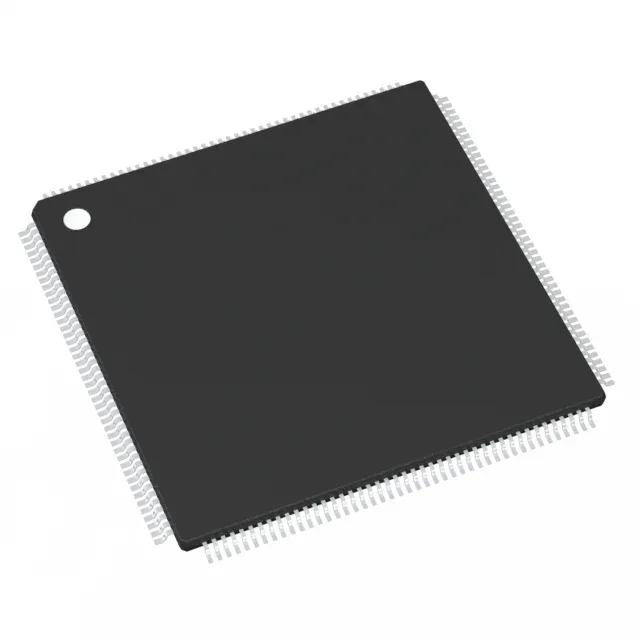
Core and memory headroom for the firmware
The STM32L552ZET6 runs an ARM Cortex-M33 core at 110MHz — the first Cortex-M with hardware TrustZone for isolation, which means the secure world and non-secure world share the same flash and RAM but the MPU enforces boundaries at runtime. 512 KB of program flash and 256 KB of SRAM are both on-chip; the flash is split into 2-KB sectors for granular erase, so a bootloader update can rewrite one sector without touching the rest of the application. The 256 KB SRAM is a single bank with parity, which is enough to hold two full 128 KB frame buffers or a moderate real-time OS heap plus the stack. For a sensor fusion or motor control loop that runs a 1 kHz control task, the 110 MHz clock gives roughly 110 000 cycles per interrupt — plenty of margin for a PID update and a few peripheral register accesses.
Peripheral set and connectivity
The part carries CANbus, I2C, IrDA, LINbus, MMC/SD, QSPI, SAI, SPI, UART/USART, and USB — the QSPI interface lets you attach external NOR flash or PSRAM over a quad-SPI bus without bit-banging, which is useful for over-the-air update staging or large lookup tables. The 115 general-purpose I/O pins in the 144-LQFP package give enough breakout for a parallel LCD interface, a keypad matrix, and a handful of sensor interrupts. The DMA controller can move ADC results to a circular buffer without CPU intervention, keeping the Cortex-M33 free for application logic.
Supply voltage and temperature grade
The brown-out detect and reset block monitors the supply and holds the core in reset until the rail is stable, so the boot ROM starts from a known state after a power-on or a brown-out event.