Cortex-M0 at 48 MHz — what the clock buys you
The STM32F031K4U6 runs an ARM Cortex-M0 core at 48 MHz — the 32-bit single-cycle multiply and tightly coupled interrupt controller mean the 16 KB flash can service a 1 kHz control loop with margin for protocol stack overhead. The core's 0.9 DMIPS/MHz throughput translates to roughly 43 DMIPS at full speed, enough for brushless DC motor commutation or a Modbus RTU gateway without an external co-processor.
Memory budget — 16 KB flash, 4 KB RAM
16 KB of on-chip flash (16 K x 8) and 4 KB SRAM define the application ceiling. A typical sensor-node firmware with a 2 KB bootloader, 6 KB application code, and 1 KB calibration tables leaves about 7 KB for feature growth. The 4 KB RAM holds the stack, a 256-byte DMA buffer, and a 1 KB Modbus holding register map — the remaining ~1.5 KB is scratch for the main loop. Flash is single-voltage, 2.0-3.6 V, with 20-year retention at 85 °C. No external EEPROM is needed for parameter storage if the application writes to the last flash sector — the 100 kcycle endurance per sector is adequate for once-per-minute logging over a 10-year product life.
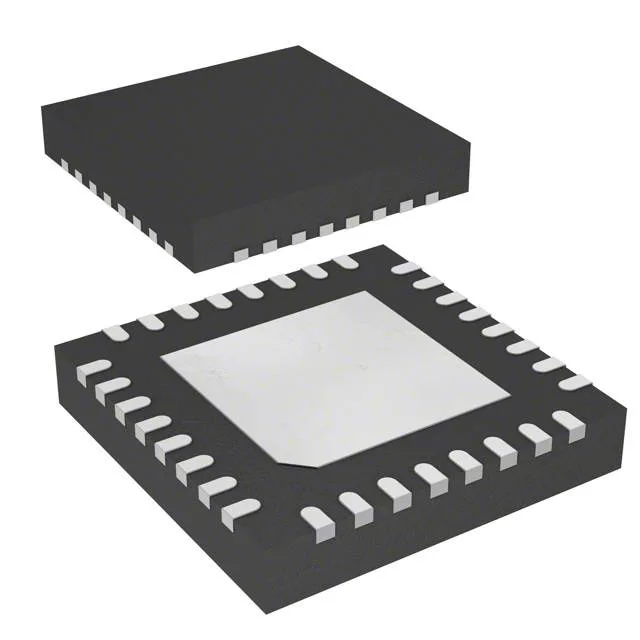
UFQFPN-32 5x5 mm — board-fit and thermal pad
The pad also provides mechanical stability; without it the package can lift during reflow if the stencil aperture is too small.
Supply voltage and temperature grade
The internal POR (power-on reset) monitors the rail and holds the core in reset until VDD reaches the threshold, so no external supervisor is needed for basic brown-out protection.
Peripheral set — ADC, PWM, serial interfaces
13-channel 12-bit ADC with 1 µs conversion time — enough to sample three phase currents in a BLDC motor drive at 10 kHz loop rate with channels left for a thermistor and a potentiometer. The 12-bit resolution gives 1.2 mV steps at 3.3 V reference, adequate for 0.1 °C temperature sensing with a 10 kΩ NTC. The PWM timer runs at up to 48 MHz with dead-time insertion, suitable for half-bridge or H-bridge control.