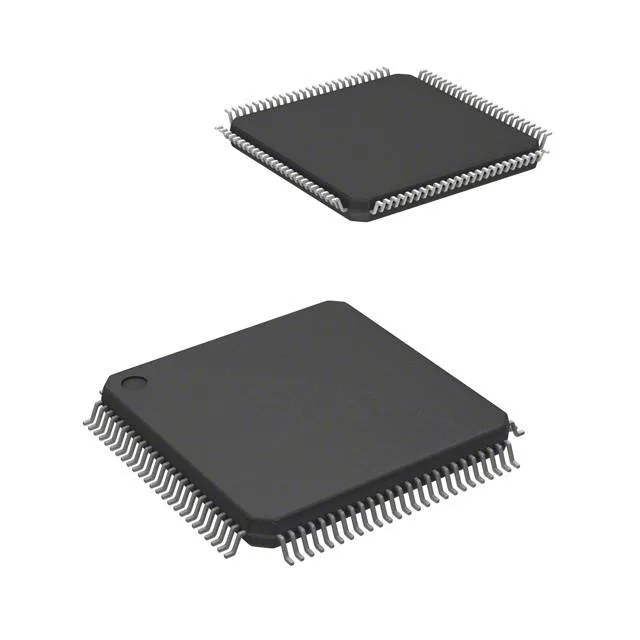
Active production — no BOM risk on this Cortex-M0+ MCU
The STM32L071VBT6: It runs a 32 MHz ARM Cortex-M0+ core — the M0+ is a single-issue, two-stage pipeline design that trades peak throughput for lower gate count and static power. At 32 MHz you get roughly 0.9 DMIPS/MHz, enough for sensor fusion, motor commutation loops, or a Modbus gateway, but not for heavy DSP or floating-point math.
On-chip memory budget for a sensor-heavy control board
128 KB flash and 20 KB SRAM with a dedicated 6 KB EEPROM block — the EEPROM is emulated in the flash array on some STM32L0 parts, but here it is a true independent array, so you can store calibration constants, node IDs, or fault logs without wearing the program flash. The 20 KB SRAM is tight for a full RTOS with multiple stacks; budget 4-6 KB for the kernel and leave the rest for application data. The 84 I/O count means you can run a parallel LCD, a row of key switches, and a dozen sensor inputs without a port expander. No external LDO needed if the input rail stays within that window, which simplifies the power tree for a battery-operated node.
Industrial temp grade and peripheral set
A controller in a factory enclosure, an outdoor sensor node in a shaded NEMA box, or a conveyor-side panel all fall inside this envelope. The 85°C ceiling is the junction temperature, not the ambient; in a sealed enclosure with no airflow, derate the clock speed or reduce the I/O drive current to stay under the limit. Connectivity includes I2C, SPI, UART/USART, and IrDA — the I2C and SPI buses are the workhorses for external ADCs, digital temperature sensors, and serial flash. The IrDA block is useful for optical isolation across a gap in a safety barrier or for a handheld programmer that talks over an infrared dongle. Peripherals include brown-out detect, DMA, I2S, POR, PWM, and WDT. The brown-out detect resets the MCU when the supply dips below a programmable threshold — critical for battery-powered gear where the cell voltage sags under load. The DMA offloads peripheral-to-memory transfers so the CPU can sleep or run the control loop while the UART fills a buffer.
Compliance and documentation
ROHS3 compliant — no restricted substances above the threshold limits. The manufacturer provides a full declaration of conformity and material composition data upon request. The 16x12-bit ADC samples up to 16 external channels — enough for voltage, current, and temperature sensing on a motor-drive board or a multi-sensor field transmitter. The 12-bit resolution gives 4096 counts over the reference range; for a 3.3 V reference, that is about 0.8 mV per count.