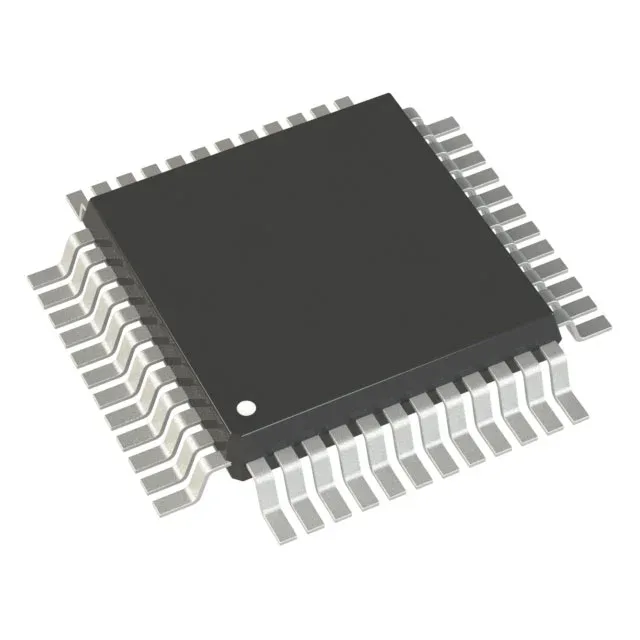
The STM32L051K6T6 comes in a 32-LQFP package with a 7x7 mm body. The 0.8 mm pitch is comfortable for two-layer boards — no micro-vias needed for fan-out. With 27 GPIOs brought out, you get enough I/O for a handful of sensors, a small display, and a serial debug interface without multiplexing. The remaining five pins on the 32-pin LQFP are power, ground, and the oscillator pins.
Memory budget for a real firmware image
32 KB of flash and 8 KB of SRAM — this is a tight but workable memory map for a dedicated control loop or a sensor hub. The HAL and a lightweight RTOS like FreeRTOS take about 8-12 KB of flash and 2-3 KB of RAM, leaving roughly 20 KB for application code and 5 KB for data. The 2 KB of embedded EEPROM is a genuine advantage: you can store calibration constants, device IDs, or boot counters without wearing the flash or adding an external serial EEPROM. The Cortex-M0+ core runs at 32 MHz — that is 32 million instructions per second on a single-cycle multiply, enough for a 10 kHz control loop with headroom for communication overhead. The internal oscillator saves two pins and a crystal, but the accuracy is ±1% typical after calibration, so skip it if you need a USB or CAN clock.
Supply voltage and temperature — where this MCU lives
At 1.8 V the flash still reads at full speed, so you can run the core at 32 MHz right down to the low end of the range. The operating temperature is -40°C to 85°C, which is the industrial grade: fine for outdoor enclosures, HVAC ducts, or engine bays as long as the ambient stays below 85°C. The watchdog timer (WDT) is independent of the core clock, so it keeps running even if the main oscillator fails.
Peripherals and connectivity for a sensor node
The STM32L051K6T6 has one I²C, one SPI, and two UART/USART interfaces, plus IrDA for infrared communication. That is enough to talk to a temperature sensor over I²C, log data to an SD card over SPI, and report results over a serial link. The 10-channel 12-bit ADC samples at up to 1 Msps — fine for reading a potentiometer, a thermistor, or a current-sense resistor. There is no DAC, so analog output requires an external converter or PWM with a filter. DMA offloads data transfers from the CPU — useful for moving ADC readings to RAM or streaming UART data without blocking the core. The PWM timer can generate up to four independent channels for LED dimming or motor speed control.
Lifecycle and compliance — active and ready for new designs
No minimum order quantity restrictions beyond the tray packaging.