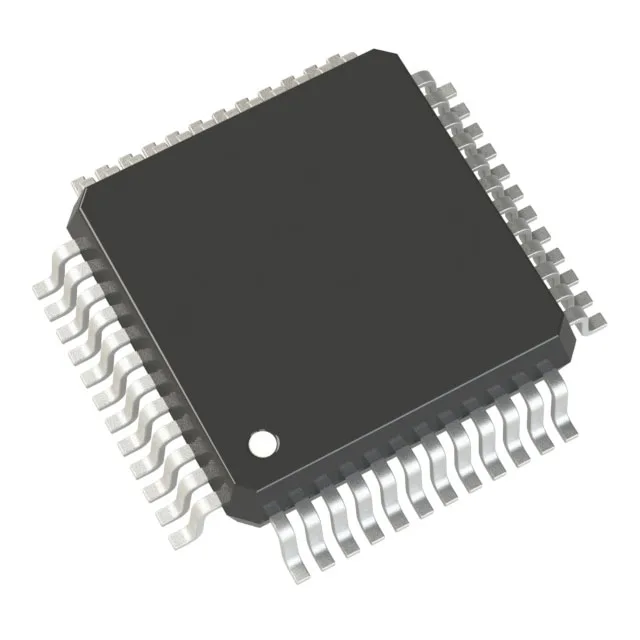
72 MHz Cortex-M4 with FPU and DSP extensions
The STM32F303C8T6: This puts it in the signal-chain MCU class — the FPU handles real-time control loops (motor FOC, digital PFC) without software emulation, and the DSP extensions accelerate FIR/IIR filter taps that a Cortex-M3 would run in multiple cycles. On-chip memory is 64 KB flash and 16 KB SRAM. For a single motor-control loop with sensor fusion (Hall + encoder + current sense), the firmware image fits in 48–52 KB, leaving 12 KB for a modest RTOS and communication stack. The 16 KB SRAM is enough for two 256-point FFT buffers (one real, one complex) plus a 1 KB CAN mailbox area — but a full GUI with a frame buffer will push past the ceiling.
48-LQFP (7x7 mm) with 0.5 mm pitch. The exposed paddle is not present — thermal dissipation relies on the leadframe and board copper. The 37 I/O lines include up to 11 ADC inputs, so the analog and digital return paths need separation at the package boundary. Supply range is 2.0 to 3.6 V — a single 3.3 V rail is typical. The internal POR and BOR (brownout reset) are programmable; at 3.3 V the BOR threshold is 2.7 V typ, so a 3.3 V rail that dips below 2.7 V during a transient triggers a reset. Decoupling: one 100 nF per VDD pair plus a 4.7 µF bulk on the main VDD rail, placed within 5 mm of the pin.
Analog front-end and connectivity
Three 12-bit ADCs (11 channels total) can be interleaved for a 5 MSPS aggregate sampling rate — enough for simultaneous three-phase current sensing at 10 kHz PWM with 12-bit resolution. The single 12-bit DAC outputs a 0–3.3 V analog signal for setpoint or bias generation. Connectivity includes CANbus (2.0B active), two I²C, two SPI (with I²S), three USARTs (one with IrDA), and a LIN interface. The CAN controller has 3 mailboxes — sufficient for a 250 kbps sensor bus with one periodic message and two event-triggered frames. The I²S interface can stream 16-bit stereo audio at 48 kHz without bit-banging.
Operating temperature -40 to 85 °C covers factory-floor enclosures, HVAC controllers, and outdoor telecom cabinets (with solar loading accounted for). Not rated for under-hood automotive (AEC-Q100) or extended -40 to 125 °C — those applications need the STM32F303xE or STM32G4 series.