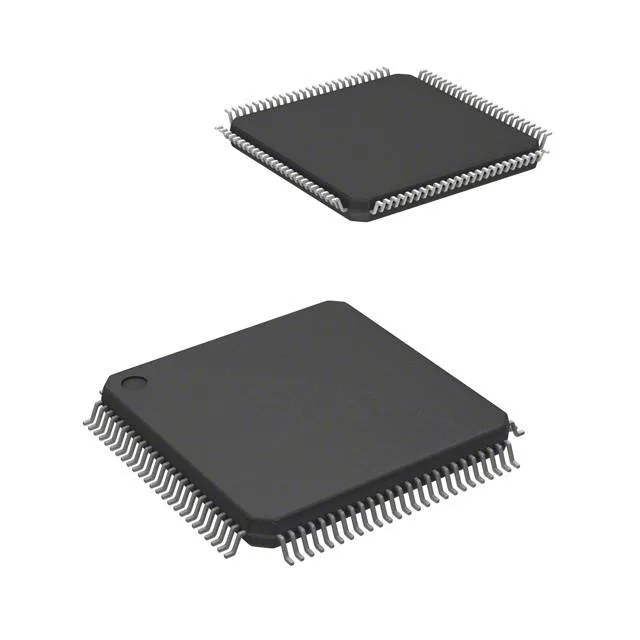
STM32F205VGT6V — 120 MHz Cortex-M3 with 1 MB Flash in a 100-LQFP
The STMicroelectronics STM32F205VGT6V is a 32-bit ARM Cortex-M3 MCU from the STM32F2 series, clocked at 120 MHz with 1 MB of Flash program memory and 132 KB of SRAM. It provides 82 general-purpose I/O lines and a rich peripheral set including CANbus, multiple I²C and SPI interfaces, USB OTG, and a 12-bit ADC with 16 channels plus a 12-bit DAC with 2 channels. This is a mid-to-high-density MCU aimed at industrial control, motor drives, and embedded systems that need a balance of processing throughput, memory headroom, and connectivity without stepping up to a Cortex-M4 or M7 part.
The 120 MHz core clock is the headline number that separates this from the STM32F1 value line and the STM32L1 ultra-low-power series. At 120 MHz the Cortex-M3 can sustain a single-cycle multiply and a 1.25 DMIPS/MHz throughput, which puts roughly 150 DMIPS on the table. For comparison, the STM32L151CBU6A — also a Cortex-M3 part — tops out at 32 MHz, which is a 3.75× speed difference. If your application runs a control loop that must close inside 10 µs, or you are bit-banging a protocol at 10 MHz, the F205's clock budget is what makes it feasible. The flash controller needs zero wait states up to 30 MHz, one wait state up to 60 MHz, and two wait states above that; the prefetch buffer and ART accelerator help keep the pipeline fed, but a tight loop that straddles a flash sector boundary can still stall.
1 MB Flash / 132 KB RAM — sizing the firmware region
The 1 MB Flash array is organised as 1M x 8 bits. That is enough for a full-featured RTOS, a TCP/IP stack, a file system, and several hundred kilobytes of application code with room left for a second-stage bootloader. The 132 KB of SRAM splits into 128 KB of main SRAM and 4 KB of backup SRAM that stays powered through the VBAT pin. The backup domain retains 32-bit registers and the RTC counter when the main supply drops. If your firmware uses a lot of DMA buffers or a large frame buffer for a small LCD, the 132 KB total is the ceiling — there is no external bus interface on this package variant, so you cannot add more SRAM off-chip without bit-banging a parallel bus through GPIO.
That covers most factory-floor equipment, outdoor telecom enclosures, and automotive cabin applications (though it lacks formal AEC-Q100 qualification). The supply voltage range is 1.8V to 3.6V, so it can run from a single Li-ion cell or a 3.3V rail.
The STM32F2 series is a mature, well-established line — the errata sheets are stable, the SDK (STM32CubeF2) is feature-complete, and the toolchain support (IAR, Keil, GCC) is mature. For production BOM planning, there is no near-term obsolescence risk.