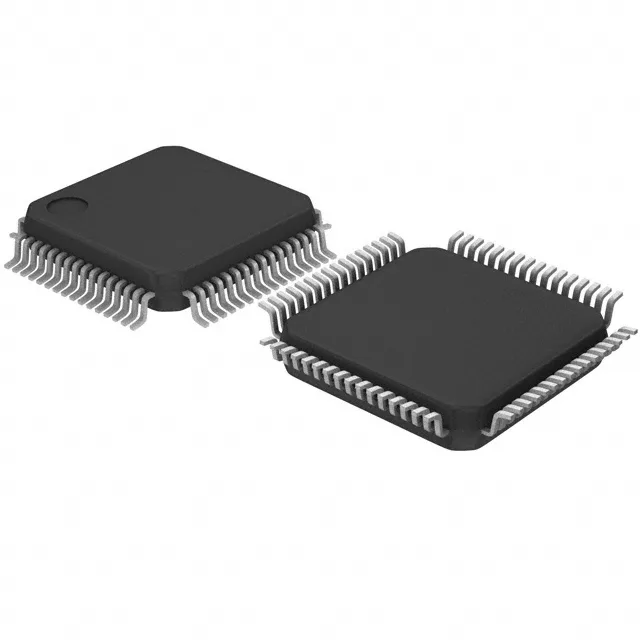
The STM32F205RGT6 is a 32-bit ARM Cortex-M3 MCU from ST's STM32F2 series, clocked at 120 MHz with 1 MB of Flash and 132 KB of RAM. It carries 51 GPIOs, a full set of connectivity — CAN, USB OTG, SPI, I²C, UART, IrDA, LIN, and MMC — plus dual 12-bit DAC and a 16-channel 12-bit ADC. The industrial temperature range (-40°C to 85°C) and 1.8 V to 3.6 V supply make it a fit for factory automation, motor drives, industrial HMI, and embedded control where you need a single-chip compute core with peripheral integration and no external PHY for USB.
Memory and speed — sizing the part to the task
The 1 MB Flash and 132 KB RAM put this in the mid-to-high-density tier of the STM32F2 family. At 120 MHz, the Cortex-M3 delivers enough throughput for a real-time control loop (e.g., a field-oriented motor drive) while leaving headroom for a protocol stack.
Connectivity and I/O — what the peripheral set covers
The STM32F205RGT6 integrates CAN, USB OTG, SPI, I²C, UART/USART, IrDA, LIN, and MMC interfaces. For a typical industrial control board, this means one chip handles the fieldbus gateway (CAN), the operator HMI link (UART to a display), and sensor acquisition (SPI/I²C to ADCs or encoders) without external bridge ICs. The 51 GPIOs in the 64-LQFP package leave room for a parallel LCD interface or a bank of discrete I/O. The USB OTG peripheral supports host or device mode — useful for on-the-fly data logging or firmware updates via a thumb drive.
For a production BOM, this means zero obsolescence risk on the current build cycle. If you are qualifying a second source for supply resilience, note that the STM32L151CBU6A shares the same Cortex-M3 core and 12-bit ADC/DAC peripheral set, but runs at 32 MHz with lower Flash — it is not a pin-compatible drop-in, but a functional alternative for lower-performance tiers.