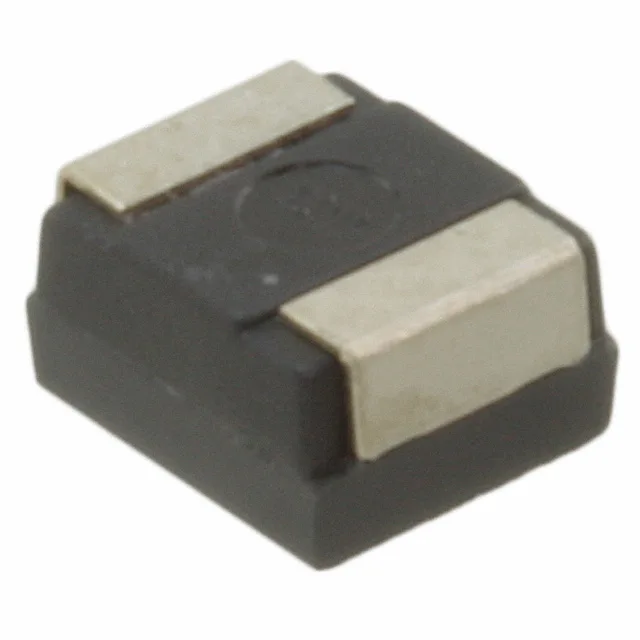
What the 220 µF / 2.5 V rating means for the BOM line
The 2R5TPE220MZB: The 220 µF capacitance at 2.5 V marks this as a bulk-decoupling or hold-up candidate in low-voltage rails — the kind of position that keeps a rail clean through a load transient or holds a charge during a brief supply dropout. The ±20% tolerance means the actual value can swing between 176 µF and 264 µF at the 2.5 V operating point, so reserve that spread in your ripple budget before committing it to a rail that needs tight regulation.
ESR and the 100 kHz switching context
For a 2.5 V rail running at that frequency, a 35 mΩ ESR produces roughly 90 mV of peak-to-peak ripple at 3 A load, which is the number to run against your downstream LC filter budget.
Thermal margin and lifetime at 105 °C
The 1000-hour rated lifetime at 105 °C places this in the moderate-temperature tier — not the ultra-long-life grade that Panasonic runs at lower temperature, but sufficient for most consumer and industrial equipment where the ambient stays below 85 °C and the capacitor runs at a fraction of its ripple current limit. Derate the ripple current per Panasonic's temperature-derating curve and the effective lifetime extends significantly past the 1000-hour datasheet figure, which is the normal practice for hold-up and decoupling positions that rarely see full ripple stress. The -55°C lower bound is the automotive and instrumentation floor — the polymer cathode does not have the cold-temperature leakage issues of wet electrolytic, so this part stays functional and low-leakage in equipment that must start at deep-cold temperatures without warm-up time.
Package footprint — 1411 (3528 metric) for compact layouts
The 3.50 mm × 2.80 mm body with a 2.00 mm seated height fits the standard 1411 footprint — a common land-pattern for compact bulk-decoupling in portable electronics, handheld instruments, and modules where board area is budgeted at the capacitor level. The size code ties to Panasonic's internal construction spec, which is relevant when cross-referencing replacement candidates in the same series: a different B-code means a different die or polymer stack, not just a different packaging.