Low ESR at 100kHz — the POSCAP advantage for high-frequency rail decoupling
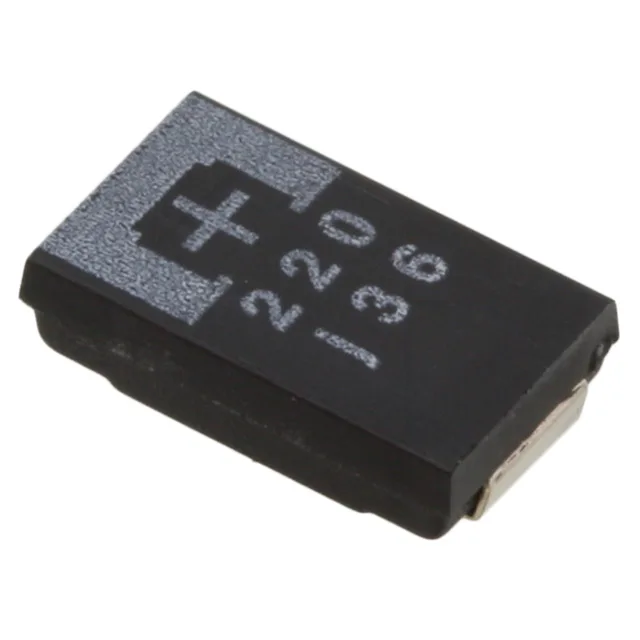
The 2R5TPE330MF: The 15mΩ ESR at 100kHz is the headline figure for this POSCAP — polymer tantalum construction holds impedance flat across the frequency band in a way that electrolytic alternatives cannot, which is exactly why these land on intermediate bus rails and CPU/GPU decoupling nodes in servers and dense power-conversion boards. At 330µF the bulk capacitance is sufficient to absorb current transients at the 2.5V rail; the ESR floor determines how much ripple voltage appears at the switching frequency.
105°C thermal grade and 2000-hour rated lifetime at temperature
The 2000 Hrs @ 105°C rating sets the design life anchor — for a server board or networking switch that runs hot inside a sealed enclosure, the capacitor sees ambient temperature plus self-heating from ripple current. POSCAP ESR rises with temperature, so the 105°C rating is the upper bound for continuous operation; a 2.5V part run near its voltage rating in a high-ripple environment needs thermal headroom factored into the layout.
7343 molded SMD footprint — what the board layout needs
The D2E manufacturer size code identifies the specific production lot variant; pad layout should follow the recommended land pattern for the 7343 case per Panasonic's POSCAP datasheet to ensure solder joint reliability under thermal cycling. Tape-and-reel packaging is standard for production quantities; cut tape is available for prototyping runs.