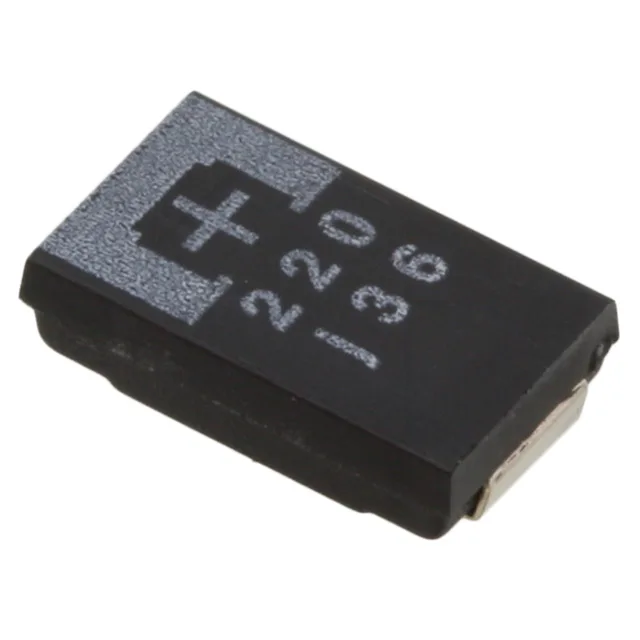
The 220µF at 2.5V rating — why it lands on a BOM
The 2R5TPE220M9: At 220 µF and 2.5 V, this is a bulk-decoupling or input-rail smoothing capacitor — the kind you drop on a dc-dc converter input or a load point's VCC rail to absorb ripple current and hold up the rail during transients. The 2.5 V rating is a low-voltage rail rating, so check your nominal rail sits comfortably below it with enough headroom for transients. The ±20% tolerance means the actual capacitance can swing from 176 µF to 264 µF over production and temperature — fine for bulk decoupled rails where absolute value matters less than having enough capacitance to absorb current spikes.
The 9mΩ ESR at 100kHz — what low impedance buys you
A higher-ESR aluminum capacitor at the same capacitance would start filtering at a lower frequency and leave you with more ripple on the rail. The ESR is specified at 100 kHz, which aligns with the switching node frequency of most synchronous buck converters. If your converter runs at 300 kHz or 500 kHz, model the impedance curve — the ESR stays low but the ESL and the board inductance set the actual Z at those frequencies.
105°C rated, 2000-hour lifetime — the thermal reality
2000 hours at 105°C is the accelerated lifetime rating Panasonic uses to project useful service life. At 85°C ambient with self-heating from RMS ripple current, the capacitor runs cooler and the effective lifetime extends significantly — the Arrhenius relationship roughly doubles life for every 10°C drop. Use it in an industrial enclosure with moderate airflow and the 2000-hour figure is conservative. The -55°C lower limit puts this in the industrial temperature band — cold enough for outdoor or vehicle-adjacent deployments, warm enough to survive a cold-store without condensation issues if the board is conformal coated.
2917 SMD package — footprint and rework reality
The 2917 (7343 metric) package is a medium-sized tantalum polymer case — larger than a 1206 chip but smaller than a full can electrolytic. The 7.30 mm × 4.30 mm body and 2.00 mm seated height fit a standard land pattern; the molded body survives reflow without the cracking risk that plagues bare tantalum in some board flex scenarios. Rework-wise, a hot-air station at 260-280°C with pre-bake at 125°C for 4-6 hours drives off moisture before you reflow — the molded body is more moisture-tolerant than a bare tantalum chip but still follows JEDEC MSL levels. The orientation dot or chamfer on the cathode side is usually visible; check the reel label or the product drawing for pin 1 if you are reballing for a socket adapter.