What PhotoMOS means for the signal path
The AQY225R3VY is a PhotoMOS solid-state relay — the output is driven by an internal LED optically coupled to the output MOSFET, which gives galvanic isolation between the input control side and the load side. The SPST-NO (1 Form A) contact arrangement means the output path is open when de-energised and closes when the LED is driven. The output type is listed as AC, DC (RF), which means the output MOSFET handles both polarities — a key distinction from a zero-crossing TRIAC output. This matters for analog signal routing or for DC loads that reverse polarity, where a TRIAC-based SSR would not commutate correctly.
Load ceiling and on-resistance trade-off
Load current is rated at 120 mA maximum — this is a signal-level ceiling, not a power-switching rating. The on-state resistance is specified as a maximum of 14 Ω, which at 120 mA produces roughly 1.7 V across the output in the worst case. For a 100 mA signal path this is a meaningful insertion loss; for a 1 mA sense line it is negligible. The load voltage range spans 0–100 V, so the part is unsuitable for 120 VAC or 240 VAC line switching but well-suited for low-voltage analog or digital signal buses.
4-SSOP SMD tab — what it demands of the board
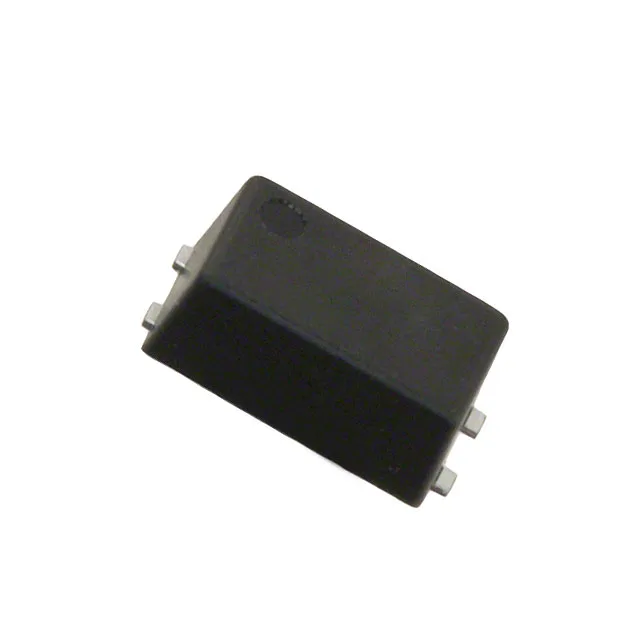
The 4-SSOP (4-SMD, 4.45 mm body width) package is a surface-mount tab-lead style. The tab termination is not a thermal pad in the power-semiconductor sense — it is the output common node — so the board layout must respect the isolation spacing implied by the load voltage rating. The part ships on tape and reel, which suits pick-and-place assembly in volume production.
Where the AQY series fits in signal switching
PhotoMOS relays of this rating are specified in test-and-measurement equipment, industrial process control, medical instrumentation, and in any application that requires galvanically isolated signal switching without the contact wear or bounce of a mechanical relay. The 14 Ω on-resistance is higher than a mechanical relay's sub-100 mΩ contact resistance, so the design trade-off is isolation versus insertion loss — the SSR wins where lifetime cycles exceed what a mechanical relay would survive, or where contact bounce cannot be tolerated in a high-speed data or timing path.
For a second-source search within the same series, the base product number AQY225 is the starting point for a parametric cross-check across the family footprint and rating spread.