What PhotoMOS solid-state architecture means for signal switching
The AQY221R2M1Y is a PhotoMOS solid-state relay — it uses an LED-phototransistor optocoupler pair to switch the load, with no moving contacts. That eliminates contact bounce, contact welding, and mechanical wearout mechanisms that govern mechanical relay lifecycle. For a BOM line carrying a signal-level switching function — a mux gate drive, a bus isolate, a sensor excitation toggle — the solid-state path trades the near-zero on-resistance of a mechanical relay contact for guaranteed silent switching and a footprint that stays consistent across temperature and vibration.
Load ratings — what 250 mA and 40 V mean for signal vs power switching
250 mA maximum load current puts this squarely in the signal-relay class — it comfortably drives LED logic inputs, comparator thresholds, and low-current solenoid coils, but it is not a power-path contact. The on-state resistance ceiling of 1.25 Ohm means the voltage drop at 250 mA sits around 300 mV — that matters when the downstream input is a low-impedance comparator or a sensitive ADC channel where offset error from relay IR drop affects the measurement. The load voltage window is 0 to 40 V — wide enough for 24 V industrial control signals and 12 V automotive rails, but the 250 mA ceiling restricts it to signal-level loads within those rails. The output type is listed as AC, DC (RF), which confirms the PhotoMOS output stage handles both polarities without a commutation diode — useful in AC signal path switching.
Input threshold — driving the relay from low-voltage logic
The LED inside the optocoupler pair fires at that threshold; below it the output stays open-circuit. Confirm the GPIO drive current against the LED forward current requirement in the full datasheet before committing the BOM line.
4-SON surface-mount package — board-density and pick-place realities
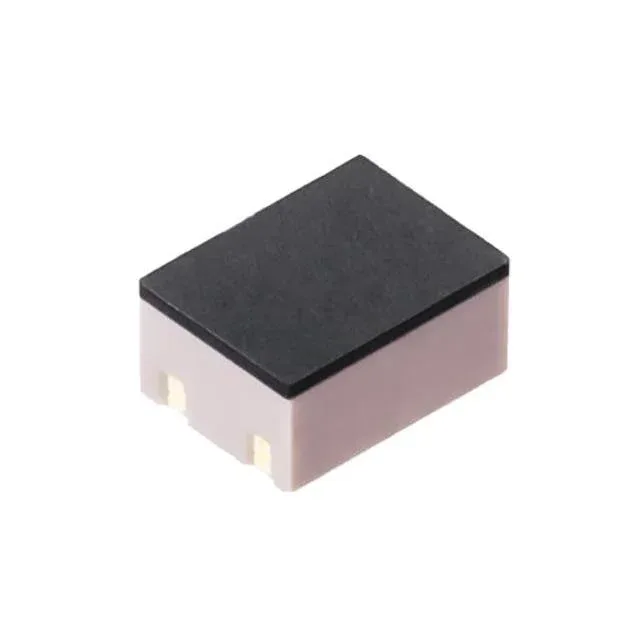
The AQY221R2M1Y ships in a 4-SMD (0.116 inch, 2.95 mm) package with a 4-SON supplier device footprint. The 2.95 mm body width is compact — it fits a dense analog front-end board where multiple signal relays sit side-by-side in a mux or bus-isolate configuration. The surface-mount termination is a tab-style SMD — confirm the pad layout and coplanarity spec against the manufacturer landing pattern before the pick-place program is locked; the exposed pad underneath the SON package must be soldered reliably or the thermal path is broken and the relay lifetime is affected.