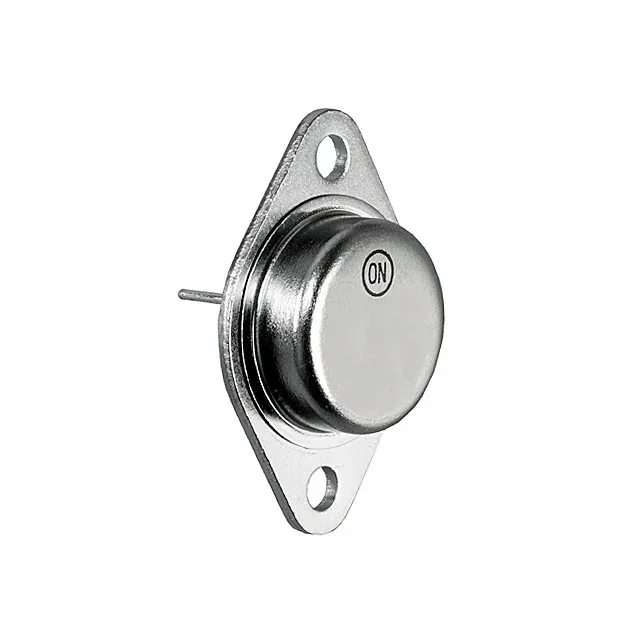
onsemi 2N3055G
TRANS NPN 60V 15A TO204
Full Technical Specifications
12 Parameters| Parameter / Attribute | Specification / Value |
|---|---|
| Mounting | Through Hole |
| FET type | NPN |
| Voltage - collector emitter breakdown | 60 V |
| Current - collector (Ic) | 15 A |
| Current - collector cutoff | 700µA |
| DC current gain (hFE) (Min) @ ic, vce | 20 @ 4A, 4V |
| Power - max | 115 W |
| Frequency - transition | 2.5MHz |
| Operating temperature | -65°C ~ 200°C (TJ) |
| Package | Tray |
| Case | TO-204AA, TO-3 |
| Vce saturation (Max) @ ib, ic | 3V @ 3.3A, 10A |
Need Stock or a Drop-in Second-Source for 2N3055G?
Package: TO-3 (TO-204AA) · Pin-compatible replacements with immediate Shenzhen spot stock
The 2N3055 NPN and its MJ2955 PNP complement are the linear power pair that ran regulator pass banks, audio output stages and industrial drive circuits for half a century: 60V, 15A, 115W in the TO-3 metal can whose body IS the collector. The family survives in original metal, in the plastic modernization (TIP3055 / TIP2955 in TO-247 at 90W) and in the modern higher-grade parts (2SC5200 / 2SA1943 class) - and the substitution traps scale with age: a mounting change disguised as an electrical equivalent, a dissipation derate hidden in the package, and a re-marking market that has targeted this exact can for decades.
Verified Pin-Compatible Replacements (3 verified alternatives)
The Same Silicon in a Plastic Body
Shenzhen Spot Stock (24-48h Dispatch)
The plastic modernization of the pair: same 60V / 15A class, 90W dissipation against the 115W of the metal can, thermal resistance about 1.39 K/W against 1.5 - and the same rule that the tab carries the collector.
Identical 60V VCEO class: the plastic move modernizes the package, not the voltage ceiling.
The 2N3055 Modernized Further Down
Shenzhen Spot Stock (24-48h Dispatch)
The TO-220 member of the lineage: 10A / 60V class where the original carries 15A - the small-board descendant of the same die culture.
Same 60V ceiling; lower current and dissipation scale with the tab size.
The Modern Grade Above the Antique
Shenzhen Spot Stock (24-48h Dispatch)
The current-generation power pair: 230V / 15A / 150W with far higher gain and speed than the 2N3055 culture - the upgrade that adds voltage headroom the TIP line never did.
230V VCEO against 60V: the only true voltage step-up on this page.
Buyer & Quality Checklist for Sourcing Alternatives
- The TO-3 can is the collector: the whole metal body bolts to the heatsink through an insulator and carries the full 15A. The insulator kit, bushings and torque are electrical parts of the design, not accessories.
- The 60V VCEO is the family ceiling, and the plastic modernizations do not raise it. Only the modern pair (2SC5200 class, 230V) steps the voltage class - a 70V-and-up rail or spiky supply needs that move, not another 60V part.
- The plastic move is a derate: TIP3055/2955 at 90W against 115W metal, different mounting, different thermal path. Re-do the dissipation and heatsink arithmetic in the same session as the substitution.
- The pair is a pair: 2N3055 with MJ2955 in output stages and pass banks. Replace both sides in the same generation; mixing a metal original with a plastic complement shifts the bias and gain balance the circuit was trimmed around.
- This can is a re-marking classic: cheap lower-class dies have been stamped 2N3055 for decades. Curve-trace gain and saturation behavior before batch fitting, and buy lots whose date and packaging survive inspection.
- Original designs assumed a slow, low-gain part: hFE 20-70 at 4A. A fast high-gain substitute in an old audio or regulator loop can oscillate - matching the working point matters as much as matching the numbers.
Frequently Asked Technical Questions
Q: Can TIP3055 replace 2N3055?
A: Electrically close - same 60V / 15A class - but not mechanically: TO-3 socket against TO-247 through-hole, and 90W dissipation against 115W. It is the standard modernization with a board-level mounting change and a thermal derate to design in.
Q: What is the PNP complement of the 2N3055?
A: The MJ2955. The two serve as a pair in output stages and regulator pass banks, and substitutions should keep the pair in one generation - mixing them shifts the bias balance.
Q: Why do fake 2N3055 parts fail in audio amplifiers?
A: Re-marked cans carry lower-class dies: the safe operating area and gain curves do not match the datasheet, so they fail at real rail voltages and real reactive loads. Curve-trace what arrives before it goes into a repair that must not come back.