ARM Cortex-M4 at 100 MHz — what the core speed buys you
The Cortex-M4 includes a single-cycle multiply-accumulate (MAC) and a single-precision floating-point unit (FPU), so the core can handle a PID loop or a fast Fourier transform without a software emulation tax. The 100 MHz ceiling means the CPU can sustain about 125 MIPS (Dhrystone 2.1) — enough for real-time control in motor drives, digital power supplies, or sensor fusion nodes where a slower Cortex-M0 or M3 would leave the control loop starved.
Program memory is 512 KB of Flash, organised as 512K x 8. That is enough for a full RTOS-based application with a TCP/IP stack, a CANopen or Modbus protocol layer, and a moderate bootloader. The 128 KB SRAM (128K x 8) holds the stack, heap, and DMA buffers. For a design that streams ADC data at 1 Msps, the 128 KB gives about 64 ms of FIFO depth at 16-bit samples — enough to absorb SD card write latency or USB packet jitter. If the application needs more, the EBI/EMI interface can gluelessly attach an external SRAM or NOR Flash.
The 105°C upper limit gives about 15°C of headroom above the typical 85°C industrial ceiling, which matters when the MCU sits near a power stage or in a sealed enclosure with no active cooling.
Peripheral set and analog conversion
The DMA controller can feed the ADC results directly to memory or to the PWM timers for closed-loop control without CPU intervention. The internal oscillator means the MCU can run without an external crystal for cost-sensitive designs, though an external clock improves timing accuracy for CAN or USB.
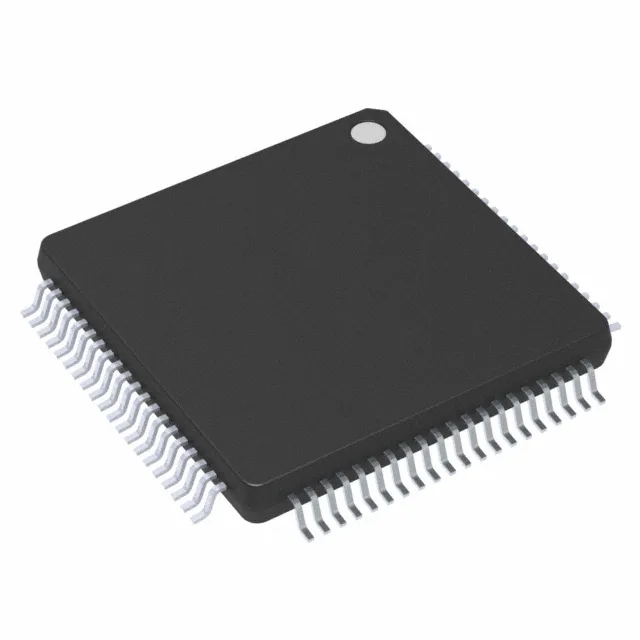
Package and footprint — 80-LQFP (12x12 mm)
The MK10DN512VLK10R comes in an 80-pin LQFP (supplier device package 80-FQFP, 12x12 mm body). The part is surface-mount only.