Parametric profile and supply-rail fit
The MIC5319-2.5YD5-TR is a fixed 2.5 V output LDO from Microchip Technology's MIC5319 family, rated for 500 mA continuous output with a maximum dropout voltage of 0.4 V at full load. Quiescent current is 150 µA typical, making it a reasonable fit for battery-powered peripherals that spend most of their time in active operation rather than deep sleep — the Iq is low enough to avoid draining a Li-ion pack overnight but not as aggressive as the sub-1 µA class of LDOs meant for always-on domains. The TSOT-23-5 package keeps the thermal footprint small, but at 500 mA the power dissipation (0.4 V × 0.5 A = 200 mW worst-case dropout) stays within the package's capability as long as the board has a modest copper pour under the part.
PSRR profile for noise-sensitive rails
Power-supply rejection ratio is specified at 70 dB at 1 kHz, rolling off to 60 dB at 10 kHz. This means the LDO attenuates 1 kHz ripple on the input by a factor of about 3160×, dropping to about 1000× at 10 kHz. For an analog front-end powered from a switching pre-regulator switching at 1–2 MHz, the PSRR above 100 kHz is not given in this spec — you will want a post-filter or a second LDO stage if the switching fundamental or its harmonics fall in the audio or low-MHz band. The enable pin (Control Features: Enable) lets the system shut the LDO down to near-zero quiescent current when the rail is not needed — useful for sequencing multiple supply domains on a single board without adding a separate load switch.
Protection and package reworkability
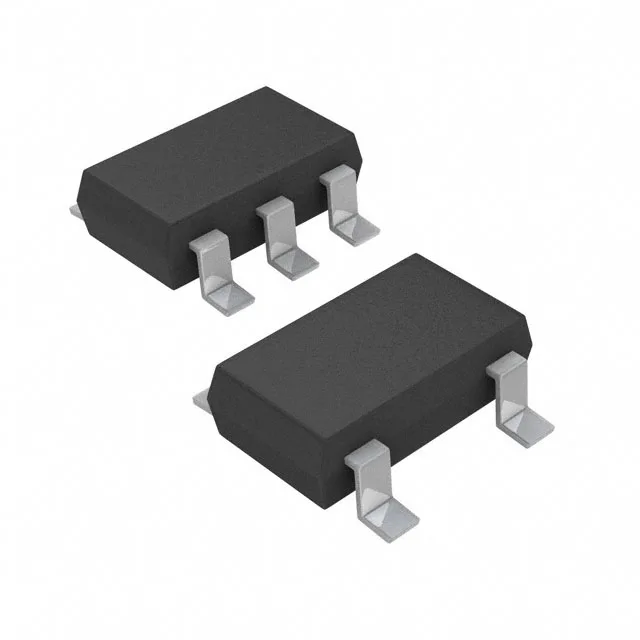
Supplier device package is TSOT-23-5, a thin variant of the standard SOT-23-5. The reduced body height (typically 0.9 mm seated) helps in tight enclosures but the thermal pad is the same size — do not expect better thermal performance than the standard SOT-23-5 footprint.
Voltage variant and BOM flexibility
The closest functional peer within the same family is the MIC5319-3.3YD5-TR, which shares the same 500 mA output, TSOT-23-5 package, PSRR profile, and protection features but delivers a fixed 3.3 V output. If your BOM calls for a 2.5 V rail but a 3.3 V variant is already qualified, the layout is identical — only the output voltage changes.