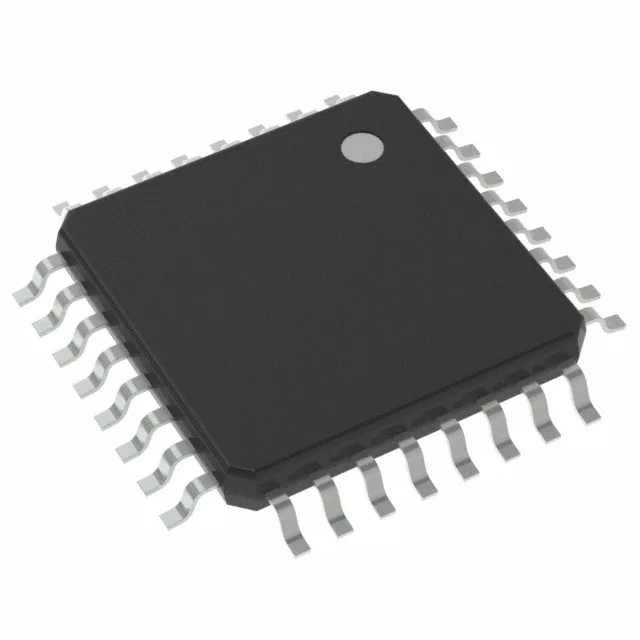
ATMEGA328P-AU - Microchip Technology
Full Technical Specifications
18 Parameters| Parameter / Attribute | Specification / Value |
|---|---|
| Series | AVR® ATmega |
| Mounting | Surface Mount |
| Oscillator type | Internal |
| Program memory type | FLASH |
| Voltage - supply (Vcc (Vdd)) | 1.8V ~ 5.5V |
| Operating temperature | -40°C~85°C(TA) |
| Speed | 20MHz |
| Package | Tray |
| RAM size | 2K x 8 |
| Core size | 8-Bit |
| EEPROM size | 1K x 8 |
| Peripherals | Brown-out Detect/Reset, POR, PWM, WDT |
| Connectivity | I²C, SPI, UART/USART |
| Number of i (O) | 23 |
| Core processor | AVR |
| Case | 32-TQFP |
| Data converters | A/D 8x10b |
| Program memory size | 32KB (16K x 16) |
Need Stock or a Drop-in Second-Source for ATMEGA328P-AU?
Package: DIP-28 / TQFP-32 / QFN-32 · Pin-compatible replacements with immediate Shenzhen spot stock
The ATmega328P is the Arduino-era workhorse that escaped into industry: thousands of instrument, controller and appliance boards still run it, and repair benches re-order it every week. Genuine Microchip supply continues, and the market knows it - which is why relabeled and re-marked stock circulates (the classic tell is a bootloader that reports one signature while the silicon reads another). The two real substitution questions are the ATmega328PB migration (a new device with the same socket, per Microchips own app note) and the smaller-flash siblings that share the pinout.
Verified Pin-Compatible Replacements (4 verified alternatives)
The Current-Generation AVR in the Same Footprint
Shenzhen Spot Stock (24-48h Dispatch)
Microchips successor device: same AVR core and 32KB/2KB/1KB memory map, plus a second USART, second SPI, second TWI, extra 16-bit timers, a peripheral touch controller and a unique device ID.
1.8V to 5.5V, same as the 328P; 20MHz class.
Same Silicon, Surface-Mount Form
Shenzhen Spot Stock (24-48h Dispatch)
Identical die and signature (0x1E950F) in the 32-lead TQFP - the SMD form of the same part.
1.8V to 5.5V; same 20MHz / 5V or 10MHz / low-voltage envelopes.
The AVR-Compatible Clone - With Real Caveats
Shenzhen Spot Stock (24-48h Dispatch)
A Chinese AVR-compatible MCU running to 32MHz off an internal RC oscillator (no crystal), reported about 20-30 percent faster than an ATmega328P at equal clock, plus extras the ATmega lacks: 12-bit ADC, a DAC, programmable gain amplifier and a factory GUID.
1.8V to 5.5V; 32KB flash and 2KB SRAM nominally, BUT there is no real EEPROM - EEPROM is emulated in flash and consumes program space (commonly 1KB allocated), leaving less usable flash than the ATmega.
Same Footprint, Half the Flash
Shenzhen Spot Stock (24-48h Dispatch)
The 16KB member of the same AVR family: pin-compatible with the 328P in DIP-28 and TQFP-32, identical peripherals, different signature (0x1E940B) and half the program memory.
1.8V to 5.5V; same clock envelopes.
Buyer & Quality Checklist for Sourcing Alternatives
- Read the device signature instead of trusting the label: avrdude reports 0x1E950F for a genuine ATmega328P and 0x1E9516 for the 328PB. Relabeled stock frequently shows a mismatch between the marking and the silicon - a five-second check with any ISP programmer.
- Moving to the ATmega328PB: update the toolchain part definition first, then review TQFP-32 pins 3, 6, 19 and 22 (VCC / GND / ADC6 / ADC7 on the 328P, GPIO on the PB) against the schematic before power-up.
- The -PU / -AU / -MU suffixes are DIP-28 / TQFP-32 / QFN-32 packaging; the signature and fuses are identical. Cross-package migration is a layout decision, not a firmware one.
- For low-voltage designs check the clock derating: full 20MHz needs about 4.5V; below that the part is specified to 10MHz class. A repair that fits a genuine 328P into a 3.3V board still runs the original firmware perfectly - the derating matters to new code only.
- When a fleet repair needs the same signature as the original boards, stay on the 328P; when the fleet is being refurbished with a firmware refresh anyway, standardize on the PB and take the extra peripherals.
- Keep fuses in the conversation: the common repair failure after a chip swap is wrong fuse bits (clock source, BOD, bootloader size), not a wrong chip.
Frequently Asked Technical Questions
Q: Is ATmega328PB a drop-in replacement for ATmega328P?
A: Same socket, new device. Microchip documents it as a successor rather than a formal drop-in: firmware toolchains must know the new device signature (0x1E9516), and in TQFP-32 the pins that were VCC / GND / ADC6 / ADC7 become GPIO, so boards tying them to rails need a check before the swap.
Q: How can I tell whether an ATmega328P is genuine?
A: Read the signature bytes with any ISP programmer: genuine 328P silicon answers 0x1E 0x95 0x0F. A mismatch between the printed marking and the signature - or a bootloader that reports a different part than the silicon - is the standard signature of relabeled stock.
Q: What is the difference between ATmega328P-PU and ATmega328P-AU?
A: Package only: -PU is DIP-28 and -AU is TQFP-32. Same die, same signature, same fuses. The -MU suffix is the QFN-32 form.