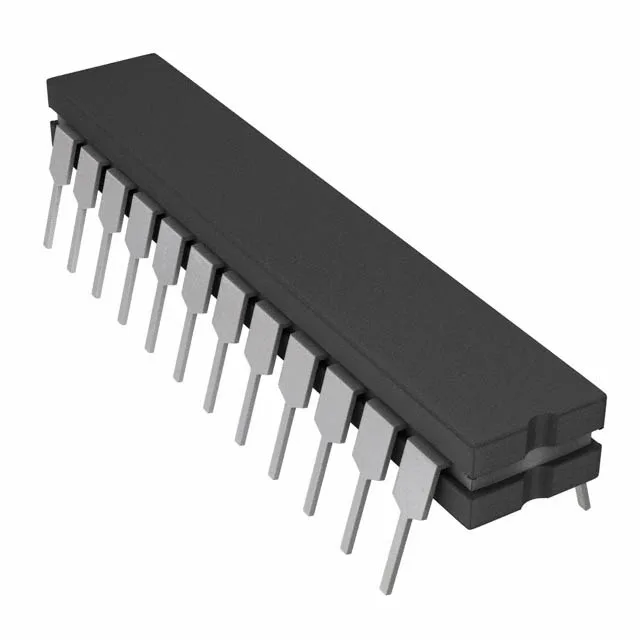
The ATF22V10C-15GM/883 is an electrically erasable programmable logic device (EE PLD) from Microchip, part of the industry-standard 22V10 architecture. The 15 ns propagation delay (tpd) sets the maximum combinatorial path delay from any input through the sum-of-products array to any output — at 5V supply and 25°C junction. In a 5V TTL backplane or memory-mapped I/O decode application, that 15 ns buys roughly 66 MHz registered operation, but the real constraint is the combinatorial delay through the AND/OR array: a 4-product-term sum takes the full 15 ns, so the system clock period must accommodate the worst-case path plus register setup time.
10 macrocells — logic capacity for glue and state machines
Ten macrocells, each configurable as registered or combinatorial output with programmable polarity. The 22V10 architecture provides 132 product terms total (12 per macrocell, plus 8 dedicated input terms). This is enough for address decoding in a 16-bit processor system, a simple 8-state sequencer, or bus-arbitration logic. The EE PLD technology means the configuration is stored in EEPROM cells — no UV erasure needed, and the part can be reprogrammed in-system if the socket allows it.
24-CDIP hermetic ceramic — the /883 screening
The /883 suffix and 24-CDIP package (0.300-inch body width, 7.62 mm) identify this as a MIL-STD-883 screened device. The through-hole mounting (0.100-inch pitch) suits socketed or soldered assembly on ceramic or FR4 boards with plated through-holes.
5V supply — legacy system fit
Single 5V supply rail, with 5V-tolerant inputs and outputs that drive TTL levels directly. In a mixed-voltage board (3.3V core, 5V peripheral), this PLD sits on the 5V rail and interfaces to the 3.3V domain through a level translator or open-drain buffer — the outputs are not 3.3V-compatible without external pull-ups or a voltage translator. The 5V supply also sets the input threshold at TTL levels (VIL max 0.8V, VIH min 2.0V), so it works with 3.3V logic if the 3.3V driver's VOH exceeds 2.0V.
Microchip lists the ATF22V10C-15GM/883 as Active (current production). The 22V10 architecture is a mature, widely second-sourced family — if Microchip ever issues an EOL, the form-fit-function replacement path is straightforward across multiple suppliers.