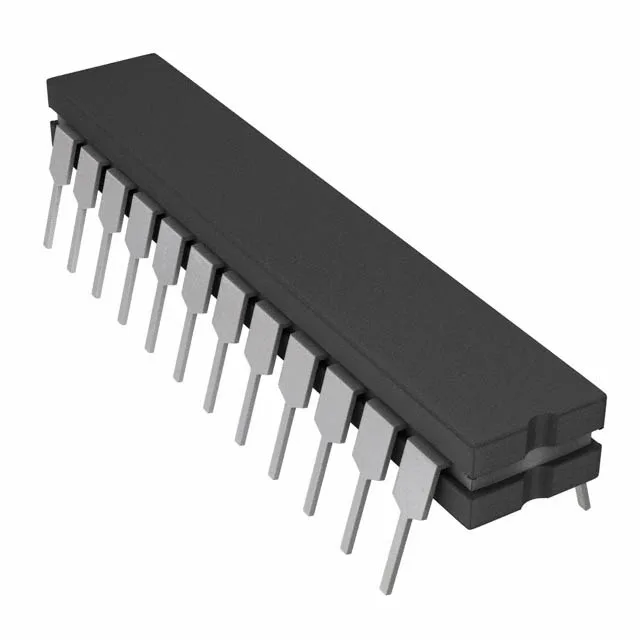
10 ns registered-logic PLD in a hermetic ceramic DIP
The Microchip ATF22V10C-10GM/883 is an electrically-erasable programmable logic device (EE PLD) from the industry-standard 22V10 series, offering 10 macrocells with a propagation delay of 10 ns. It operates from a single 5V supply and is housed in a 24-lead ceramic DIP (24-CDIP, 0.300-inch body width) — a hermetic package qualified for military/aerospace temperature-range applications. The 10 ns speed grade places it in the fast-logic tier for registered state machines, address decoding, and bus-interface glue logic where timing margin is tight.
The 10 ns propagation delay (tPD) is the pin-to-pin combinatorial path delay at 5V and 25°C. For registered logic, the maximum clock frequency is set by the internal register-to-register path, which is faster than the combinatorial tPD. The 10 macrocells each contain a configurable flip-flop and feedback path, giving you roughly 10 to 20 sum-of-products terms for combinatorial logic — enough for a 16-bit address decoder, a small state machine, or bus transceiver control. If your design needs more than 10 registered outputs or wider product-term arrays, you step up to the 22V10D or the 20-macrocell ATF22V20.
Hermetic 24-CDIP — the package that matters for high-reliability procurement
The 24-CDIP (0.300-inch width, 7.62 mm) is a ceramic dual-in-line package with a hermetic seal — no plastic mold compound, no moisture sensitivity. The /883 suffix on the order code indicates the device is processed to the MIL-STD-883 test method flow for Class B (space/defense) reliability. The through-hole mounting (0.100-inch pitch) is compatible with standard DIP sockets or soldered into plated-through holes on a PCB.
The 22V10 architecture has been second-sourced for decades; if you need a backup source, the legacy AMD/AMD-compatible 22V10B parts are pin-compatible but operate at a slower speed grade — confirm timing before substituting.