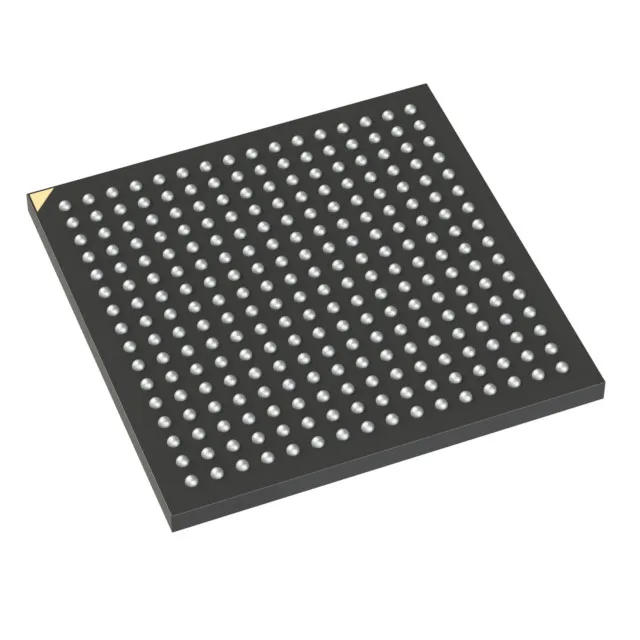
Active MachXO3 — what the 206 I/O and 4320 LEs mean for your BOM
The Lattice LCMXO3LF-4300C-5BG256I is an active-production MachXO3 FPGA with 4320 logic elements and 206 user I/O in a 256-ball CABGA package. That I/O count is the headline fit parameter: 206 accessible pins on a 14x14 mm BGA means dense board-level routing, but the 0.8 mm ball pitch still allows a 4-layer PCB without microvias — a practical trade-off for a glue-logic or I/O-expansion role. The 94 Kbit embedded block RAM (94208 total RAM bits) is sized for small FIFOs, look-up tables, or configuration registers — not for frame buffers. If your design needs more than that, the MachXO3 family steps up to the LCMXO3LF-6900C-6BG256I with 245760 RAM bits and 6864 LEs in the same 256-CABGA footprint.
Package and supply — what connects where
256-LFBGA (CABGA 14x14 mm), surface-mount, tray delivery. Operating temperature spans -40°C to 100°C (TJ), which is the industrial band. That covers outdoor telecom cabinets, factory-floor controllers, and engine-bay-adjacent enclosures where the junction sees 85°C ambient plus self-heating.
Cross-reference check — MachXO2 vs MachXO3
The closest pin-compatible sibling is the LCMXO2-4000HC-6BG256I from the MachXO2 family: same 206 I/O, same 256-CABGA package, same 94 Kbit RAM, same 4320 LEs. The difference is the core voltage — the MachXO2 runs at 2.375 V nominal vs the MachXO3's wider 2.375-3.465 V range. If your board already has a 2.5 V rail, the MachXO2 drops in without a BOM change. If you need 3.3 V I/O without a level shifter, the MachXO3 is the one. The LCMXO3LF-4300E-6MG121I is a lower-I/O (100) variant in a 121-ball caBGA — smaller footprint, fewer pins. It will not drop into a 256-ball layout without a board spin.