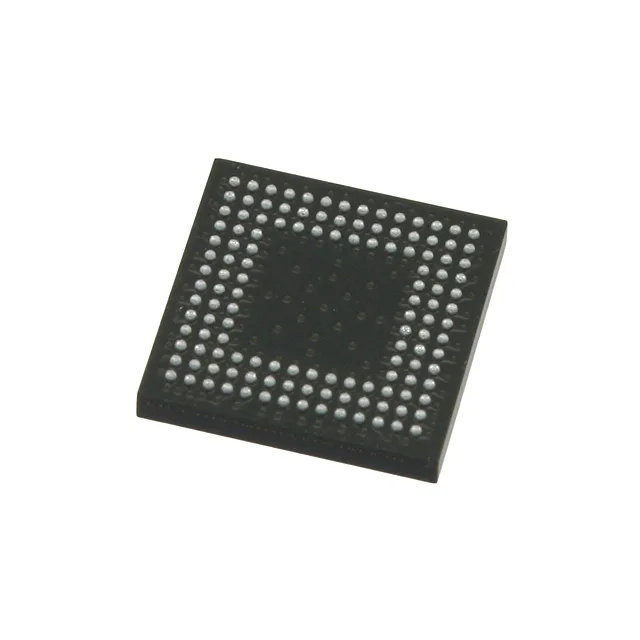
Active production — 1280 LUTs in a 8×8 mm CSPBGA
The LCMXO2-1200HC-4MG132I is an active-production MachXO2 FPGA from Lattice Semiconductor, built around 1280 logic cells organized into 160 LABs/CLBs. That puts it at the entry point of the MachXO2 family — enough density for glue logic, I/O expansion, or a small state machine, but not for a full soft-core processor without external memory. The 132-ball CSPBGA (8×8 mm) breaks out 104 I/O — every ball on the perimeter is an I/O, with the centre balls reserved for core and I/O supply. The 0.50 mm ball pitch demands a via-in-pad or microvia fan-out on a four-layer board; two-layer routing will trap the inner rows.
The core and I/O banks share the same voltage, so level translation to a 1.8 V or 1.2 V peripheral needs an external translator on the board. The 100°C TJ ceiling means the ambient temperature inside the enclosure must stay below about 85°C with typical airflow; a sealed box with no fan will push the junction above the limit on a hot day. On-chip RAM totals 65536 bits (64 Kbit) of distributed SRAM — there is no block RAM on this device. Each slice of logic can implement a small FIFO or register file, but a 1024×16 buffer would consume roughly a quarter of the available LUTs. For larger memory, plan on an external SPI SRAM or serial flash.
Package footprint and rework considerations
The 132-CSPBGA (8×8 mm) uses a 0.50 mm ball pitch with a full-area array. The supplier device package is 132-CSPBGA (8×8) — the same footprint as the commercial-temperature sibling LCMXO2-1200HC-4MG132C, so a single PCB layout serves both temp grades. The package is supplied in a tray — not tape-and-reel. For high-volume pick-and-place, a tray-to-reel conversion is needed; the tray quantity is typically 260 pieces per tray, but confirm the exact count with the supplier at RFQ.
Sourcing posture — active, quoted to order
The device is fully compliant for EU RoHS markets without a waiver.