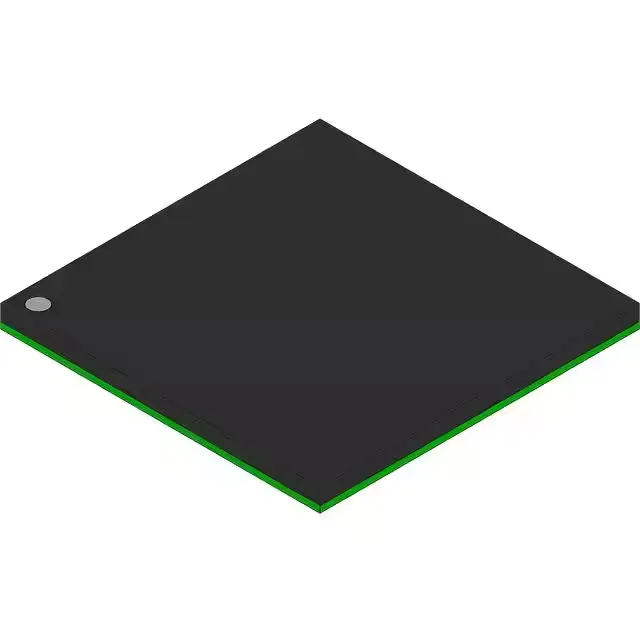
128-macrocell CPLD in 256-ball BGA
The Intel EPM7128BFC256-7 is a MAX 7000B CPLD with 128 macrocells organised into 8 logic element blocks, delivering 2500 usable gates for glue-logic, state-machine, and decode functions in a single-chip programmable logic solution. Its 7.5 ns pin-to-pin propagation delay (tpd) means combinatorial signals propagate through the device in under one 133 MHz clock period — fast enough for address decoding, bus arbitration, and control logic in 100 MHz-class processor systems without external wait states. The 100 user I/O pins, each configurable as input, output, or bidirectional, connect directly to the 256-ball BGA's outer rows — the 17×17 mm FBGA footprint (supplier device package 256-FBGA) demands a 4-layer PCB for fan-out of the inner ball rows.
2.5 V core, in-system programmable
The MAX 7000B family supports multiple I/O voltages through VCCIO pins, but the core voltage is fixed at 2.5 V. In-system programmability (ISP) via the JTAG interface means the device can be programmed and reprogrammed after soldering — no UV eraser or socket adapter needed. A standard USB-Blaster or ByteBlaster II cable drives the TCK, TMS, TDI, TDO lines at 3.3 V levels; the core voltage is supplied by the board's 2.5 V regulator. For industrial or automotive temperature ranges, the MAX 7000A or MAX 7000S families in -10 or -15 speed grades are the alternatives.
Active lifecycle, RoHS non-compliant
This part is RoHS non-compliant — the solder balls and internal metallisation contain lead. It is exempt under the RoHS directive's annex for high-reliability and legacy applications, but it cannot be used in new designs requiring full RoHS compliance without an exemption claim. The 256-BGA package is moisture-sensitive; MSL level should be verified from the latest Intel packaging data sheet before the reflow profile is set.