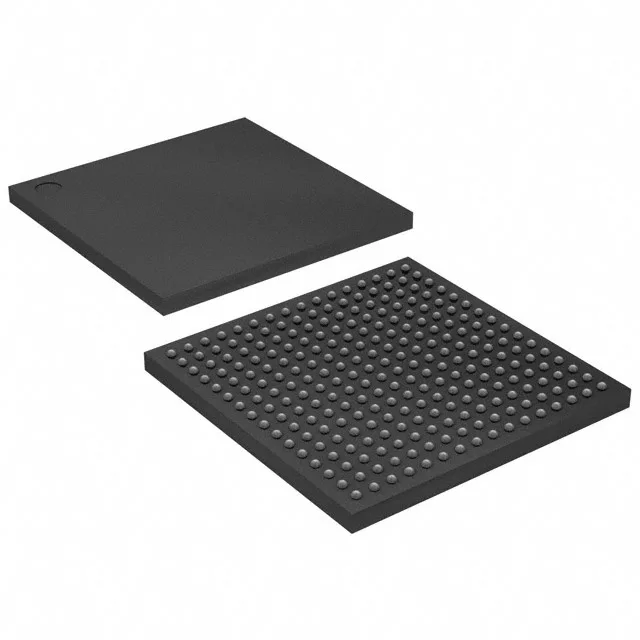
The EP4CE40F29C8LN is listed as Active on Intel's lifecycle status, so there is no end-of-life pressure for new designs or ongoing production builds. This is a Cyclone IV E device, Intel's low-power, low-cost FPGA family aimed at volume applications where the 1.0V core (0.97V~1.03V supply range) keeps dynamic power in check.
Logic budget and memory for the design
39,600 logic elements (LEs) across 2,475 LABs/CLBs define the gate budget — enough for a soft-core processor plus moderate DSP or packet-processing logic without starving the fabric. 1,161,216 total RAM bits (about 142 KB) are on-chip for FIFO buffers, small lookup tables, or block memory; designs needing larger external memory run the 532 I/O to a DDR or SRAM bus.
780-BGA — board and assembly realities
The 780-FBGA (29x29 mm) package with 532 user I/O means the PCB needs at least a 6-layer stack-up to fan out the BGA balls without buried vias under every pad. Surface-mount only — no through-hole option. The 0.97V~1.03V core rail requires a dedicated voltage regulator with tight tolerance; the 1.0V plane should be isolated from the 2.5V and 3.3V I/O banks.
The 0.97V~1.03V core supply means the voltage regulator's setpoint accuracy and load transient response directly affect timing closure; a 30 mV droop on the 1.0V rail can shift internal delays by several hundred picoseconds.