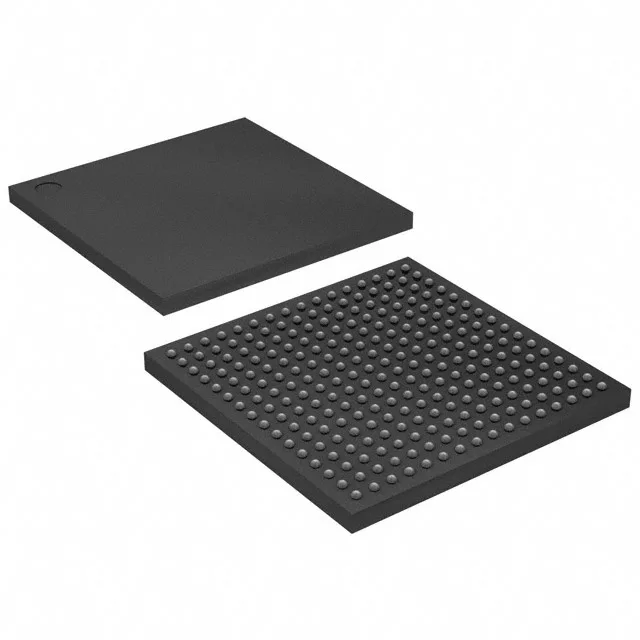
15,408 logic elements in a 17 mm square
The EP4CE15F17C9L is an Intel Cyclone IV E FPGA with 15,408 logic elements distributed across 963 LABs/CLBs. That density lands it in the mid-range of the Cyclone IV E family — enough for a soft-core processor plus peripheral glue logic, or a modest DSP pipeline, without bumping up to the 22,320-LE parts. On-chip memory totals 516,096 bits, which is roughly 63 KB of block RAM. For a typical 32-bit RISC-V core with 8 KB each for instruction and data cache, that leaves about 47 KB for FIFOs, line buffers, or coefficient storage — enough to avoid external SRAM in many control-loop and interface applications. The 165 user I/O are banked and support multiple I/O standards including LVDS, SSTL, and HSTL per the Cyclone IV E datasheet. The 256-FBGA package with a 17x17 mm body and 1.0 mm ball pitch is a four-layer-board-friendly footprint — the outer two rows of balls can be broken out on a two-layer board for simpler designs, though the inner rows require at least four layers for full fan-out.
Core supply tolerance and temperature grade
The core voltage range is 0.97 V to 1.03 V — a tight 3% window that demands a regulated supply with ±1.5% set-point accuracy or better. A standard 1.0 V LDO with 1% initial tolerance and 50 mV dropout at the required current will hold the rail inside the window across load steps and temperature, but a switching regulator needs careful output ripple management to avoid excursions below 0.97 V. Operating temperature is 0°C to 85°C junction — the commercial-grade range. This covers most indoor and telecom central-office environments but excludes automotive cabin or outdoor enclosure applications where ambient can exceed 70°C. For those, the industrial-grade suffix (I7) variant is the correct choice. The exposed center pad is not present on this package variant — all thermal dissipation is through the solder balls and the PCB copper planes.