Logic fabric and resource budget
The EP4CE10F17C6N packs 10,320 logic elements (LEs) arranged into 645 LABs — each LAB holds 16 LEs, so the routing fabric stays reasonably fine-grained for glue logic or small state machines. The 179 user I/O break out to the 256-ball FBGA, leaving 77 balls for power, ground, and dedicated clock inputs. Count the LUTs honestly: 10,320 LEs is about 8,000 usable four-input LUTs after the register-per-LE overhead; a design that needs 9,000 LUTs will push packing to the edge.
Memory and I/O for the BOM
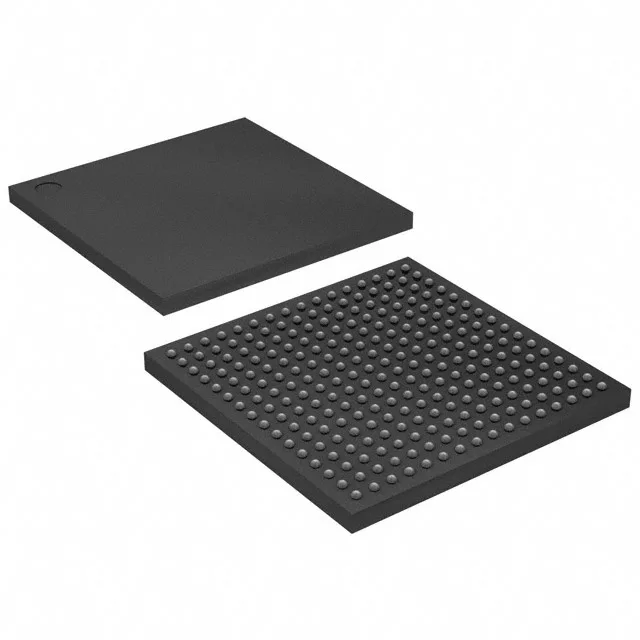
On-chip block RAM totals 423,936 bits — roughly 53 KB. That is enough for a small packet buffer, a coefficient table, or a dual-port FIFO for crossing clock domains. The 256-ball FBGA (17x17 mm) is a hand-solderable pitch — 1.0 mm ball pitch — which keeps PCB routing manageable on a four-layer board.
Temperature grade and supply
Rated for commercial operation from 0°C to 85°C junction temperature (TJ). This suits indoor equipment, telecom shelters, and industrial enclosures without active cooling — but not an engine bay or outdoor pole-mount without derating.
Intel lists the EP4CE10F17C6N as Active (current production). For a BOM that needs the commercial temp grade and the FBGA footprint, the F17C6N is the direct fit.