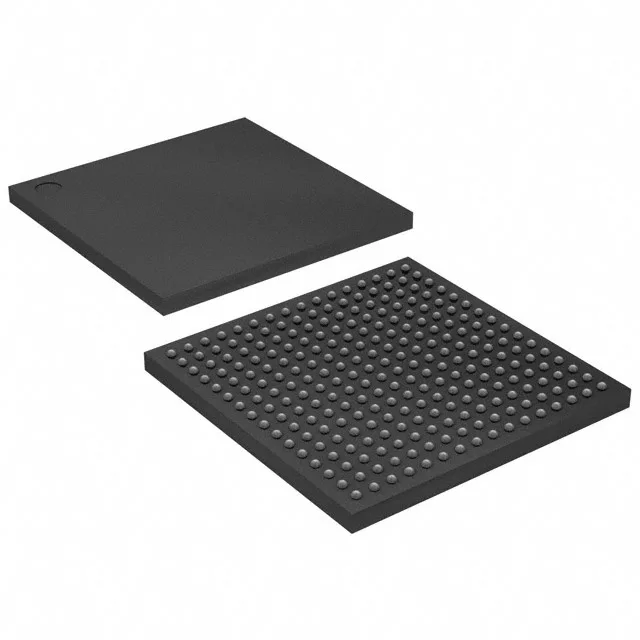
Logic density and I/O count for cost-sensitive control logic
The EP4CE10E22C8LN packs 10320 logic elements across 645 LABs/CLBs — enough for a modest state machine, a small soft-core MCU, or glue logic that would otherwise eat a dozen 74-series parts. With 91 user I/O in a 144-EQFP package, this FPGA can handle a parallel bus, a few SPI or UART peripherals, and some discrete control signals without running out of pins — typical for a motor-drive interface or a sensor-fusion bridge. The 423936 total RAM bits (about 53 KB) serve as block RAM for FIFO buffers, register files, or small look-up tables — enough for a 1024×8-bit line buffer or a 256-entry coefficient table.
1.0V core rail and exposed-pad thermal path
Core supply is a tight 0.97V to 1.03V window — the board's power rail must regulate within ±30 mV of 1.0V. A standard 1.0V LDO with 1% accuracy and good load transient response covers it, but a 1.2V rail with a post-regulator won't work without a separate supply. The 144-LQFP Exposed Pad (144-EQFP, 20×20 mm) pulls heat through the centre pad to the PCB copper plane. No AEC-Q or industrial temp suffix here.
This FPGA is still a valid choice for new designs in the Cyclone IV E family, which Intel continues to support alongside the newer Cyclone V and 10 families. The base product number EP4CE10 covers multiple speed grades, temperature ranges, and package variants. The 'C8' speed grade and 'LN' (lead-free, commercial temp) suffix are the specific BOM-fit parameters — confirm the speed grade matches your timing closure before committing.
Sourcing posture — quoted to order through independent channels
No stock-holding claim; each lot is verified for traceability and authenticity before dispatch. For a design already using EP4CE10E22C8LN, the active lifecycle means no urgent last-time-buy. For a new design, the Cyclone IV E family is mature but still viable — the newer Cyclone V offers lower power per LE if you are willing to re-spin the board.