18 mT trip, 5 mT release — the switching window
The TLE4905GT: This is a unipolar south-pole-activated Hall switch: it trips (output pulls low) when the magnetic flux density at the sensor face reaches 18 mT, and releases (output goes high) when the field drops below 5 mT. The 13 mT hysteresis prevents chatter at the switching threshold — useful in speed or position sensing where a clean digital edge matters more than absolute accuracy.
Temperature compensation and the -40 to 125 °C range
Infineon builds temperature compensation into the TLE series so the magnetic switch points stay stable across the full -40 to 125 °C junction range. In an engine-bay or industrial enclosure where the ambient swings 100 °C, the trip threshold drifts less than an uncompensated Hall sensor would — the BOM doesn't need a separate thermistor or software calibration loop. Supply voltage spans 4 to 18 V, so it runs on a 5 V logic rail or a 12 V truck battery without a regulator. The 5 mA max supply current means the thermal load on the SOT89 package is negligible even in still air.
PG-SOT89 — surface-mount fit and handling
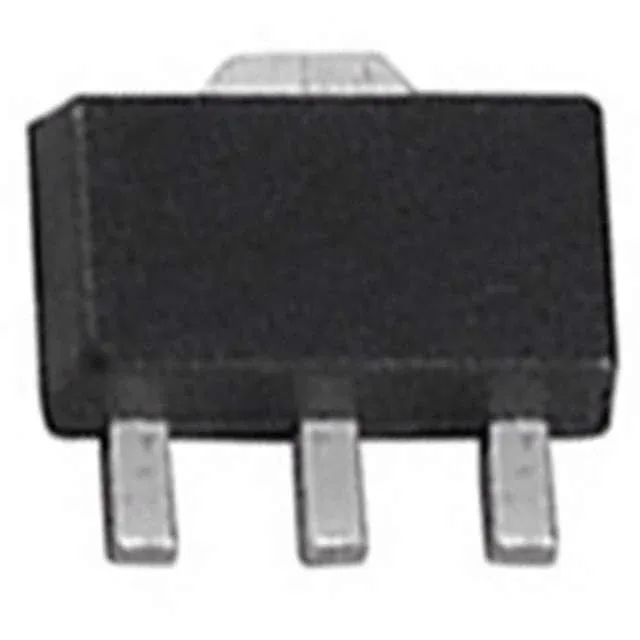
The TLE4905GT comes in the PG-SOT89 package (TO-243AA equivalent), a three-lead surface-mount package with a large collector tab on the back. The tab is internally connected to ground and doubles as a heatsink — soldering it to a copper pour on the PCB improves thermal transfer in high-ambient applications. Shipped in Tape & Reel, it's pick-and-place ready for volume assembly. The package orientation is unambiguous: the chamfered corner marks pin 1 (VCC), and the tab side is ground.