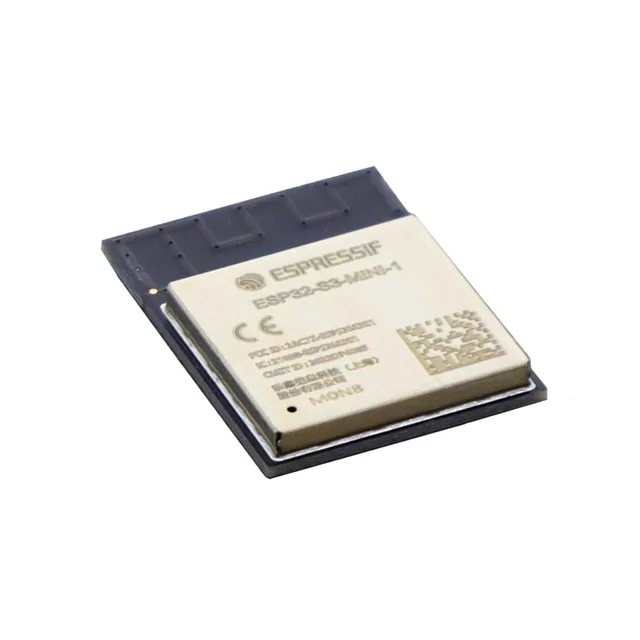
The ESP32-S3-MINI-1-N8: For a BOM decision, active status removes the single-source risk of an impending EOL. The module can be specified into a production run without planning a near-term migration to a replacement part.
Memory and core — the design budget
The module integrates an ESP32-S3R8 IC with 8 MB flash and 384 kB ROM on-chip. The 8 MB flash is the non-volatile store for application code, OTA update staging, and file-system data — enough headroom for a full RTOS stack with WiFi and BLE stacks plus a moderate application layer. The 384 kB ROM holds bootloader and core library routines; the usable RAM for the application is the internal SRAM of the ESP32-S3 die, not separately listed here but typically 512 kB in this family. Budget the firmware image size against the 8 MB flash ceiling before layout freeze.
Wireless link budget — 20.5 dBm and -104.5 dBm sensitivity
Transmit power is rated at 20.5 dBm — roughly 112 mW ERP at the antenna port. This is a high-power configuration for a 2.4 GHz module, giving roughly 3–5 dB more link margin than the typical 18 dBm parts. The receiver sensitivity of -104.5 dBm at the lowest data rate means the module can decode a signal at about -104.5 dBm, which translates to a usable range of several hundred metres line-of-sight in open air. The antenna is a PCB trace — no external antenna connector or U.FL port on this variant. The trace antenna is tuned for the module's ground plane and enclosure; if the final product uses a metal housing or a different board stack-up, the antenna resonance shifts and the radiated power drops. Plan for a radiated-spurious and TRP/TRX test in the final enclosure.
Supply rails and current draw
The receiving current is 97 mA to 100 mA; transmitting current jumps to 273 mA to 330 mA depending on the output power setting and the PHY rate. The 330 mA peak at 3.3 V is about 1.1 W peak dissipation — the 41-SMD module's copper pads and the board's thermal vias must sink that heat in still air. The 3.3 V rail should be rated for at least 500 mA to cover the module plus any external pull-ups or level shifters. A low-dropout regulator with a 3.3 V output and 500 mA capability is the standard choice; a switching regulator adds efficiency but injects ripple that can desensitise the receiver if the switching frequency falls in the 2.4 GHz band or its harmonics.
Temperature grade and environment
This covers outdoor enclosures, engine-bay-adjacent installations, and unheated warehouse environments. The module is not qualified for the full automotive -40°C to 125°C range; if the end product sees sustained junction temperatures above 85°C, the flash retention and the crystal oscillator accuracy degrade.
The ESP32-S3-MINI-1-N8 is an active Espressif product. The module ships in Strip packaging — the standard carrier for SMD modules. The 41-SMD Module footprint is a castellated-edge land-grid array; the solder profile follows the standard JEDEC J-STD-020 for a moisture-sensitive component.